Find TB to stop TB: how science has improved global guidelines for curtailing the TB/HIV syndemic
This rendering was constructed from an original PowerPoint presentation. Corrections of original text are indicated as “[corrected: X]”, redactions as “[redacted: X]”, and names withheld as “[generalized: X]”. Handouts and other auxiliary sources mentioned in the presentations are not available. The content of each presentation was believed to be correct and valid at the time of the presentation. This content, including references and links within the slides, has not been checked or updated when preparing this site. This rendering was facilitated by Anthropic Claude agentic tools for automated text extraction through computer vision and for assistance with compiling the completed sets.
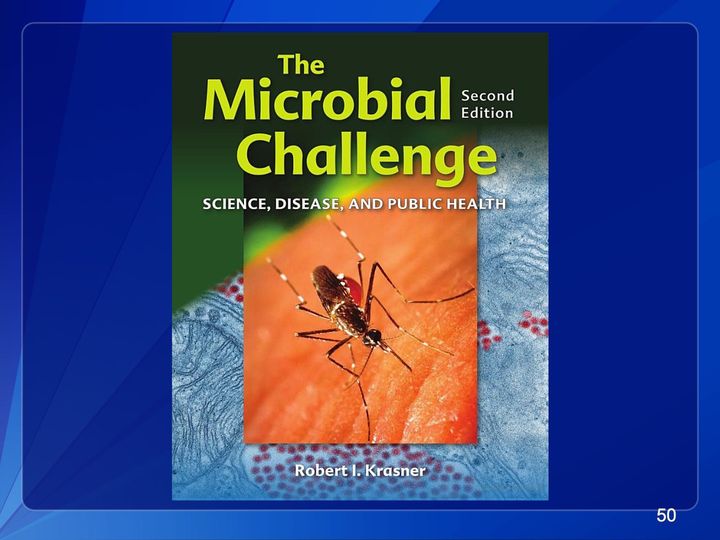
Setting: Find TB to stop TB: how science has improved global guidelines for curtailing the TB/HIV syndemic, 2011-01-13. Bard College, Citizen Science, a 3-week intensive for all new students during January intersession. The inaugural session theme was infectious diseases; students had read a TB excerpt from The Microbial Challenge by Robert Krasner.
The most exhilarating talk I ever gave felt like it came out of nowhere, and then it turned into a pivot for centering meaning and values. I was invited to speak to a class of first-year students at Bard College during their first-ever Citizen Science intersession program. It was frigid in upstate New York, with more snow than this Florida boy had ever seen.
2011-01-13, deep snow outside, warm and fuzzy inside. I gave a talk to freshmen at Bard College. Two student friends were in the audience. This was for them; everyone else got to see it. “Find TB to Stop TB: How Science Has Improved Global Guidelines for Curtailing the TB/HIV Syndemic.” How I get to use data doing things that I love, all to make the world a better place — for real. I stood before a hundred bright-eyed freshmen and declared:
I am no artist. I am a methodologist. The enigma of the citizen scientist can resolve the perceived conflict between dispassion and values — through a science literacy that acknowledges the tools and power of scientific inquiry and respects their role in how we develop knowledge about the world. The artist’s values also motivate and shape scientific endeavors, and passion itself can fuel scientific pursuits. I’m grateful to have played a small but substantial role in this one effort to stop TB and better the human condition.
I spoke to the theme of infectious diseases through my small contribution to shifting worldwide recommendations on stopping tuberculosis (TB). I wanted to give these freshmen a message that could have inspired me 2 decades earlier. So I stood with pride to share how values animate my own actions as a methodologist.
- Courage, both to ask hard questions and to act on difficult answers.
- Humility, because it is often possible and even necessary to learn from interesting mistakes.
- Creativity, because there’s no formula for telling us which interesting mistake to try to make next.
These values complement the scientific enterprise: the creativity to ask unanticipated questions, the courage to confront difficult questions, and the humility to be open to revising assumptions and knowledge. These values don’t deviate much from what animates the artist. These values matured into a schema of intellectual virtues, the traits of good learners or knowers, a defining component of my later vision for a culture for doing good things with data.
Works referred to
- Cain et al. (2010)Elsewhere on the web (opens in a new tab)
- Getahun et al. (2011)Elsewhere on the web (opens in a new tab)
- Stop TB Initiative (World Health Organization) (2011)Elsewhere on the web (opens in a new tab)
Full references: this page · whole site, by domain (opens in a new tab) · whole site, by type of work (opens in a new tab)
Text in the picture
CDC
Thank you for the opportunity to speak with you this evening and to spend some additional time with you tomorrow. I am grateful to participate in Bard College’s inaugural event promoting scientific literacy and civic engagement as part of a liberal arts education.
Acknowledgements:
A Bard-connected family, for brokering the connection to Bard [generalized: named acknowledgment];
Faculty colleagues at Bard, for inviting me and facilitating my arrangements [generalized: named acknowledgment];
Collaborators at CDC and WHO; and,
Viewers like you. Thank you.
Abbreviations: AIDS = acquired immunodeficiency syndrome; CDC = Centers for Disease Control and Prevention; HIV = human immunodeficiency virus; STD = sexually transmitted disease; TB = tuberculosis; WHO = World Health Organization.

Text in the picture
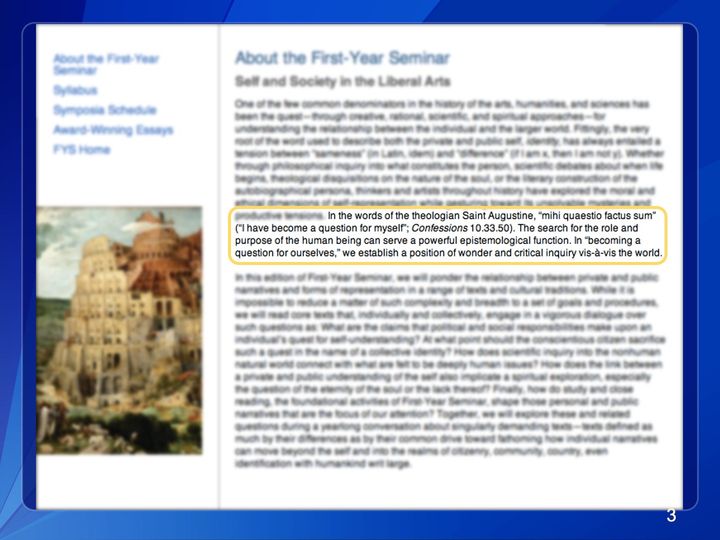
About the First-Year Seminar
Self and Society in the Liberal Arts
[two paragraphs of course description, about 330 words, not transcribed]
As I was preparing to speak here this evening, I looked through Bard’s website to get a better idea of my audience. I thought it might be more engaging if I connected my story with yours. So I’ve been reflecting on the relationship between “Self and Society” and “Citizen Science”.
[Website: http://inside.bard.edu/fys/about/]
Text in the picture (summary)
In the words of the theologian Saint Augustine, "mihi quaestio factus sum" ("I have become a question for myself"; Confessions 10.33.50). The search for the role and purpose of the human being can serve a powerful epistemological function. In "becoming a question for ourselves," we establish a position of wonder and critical inquiry vis-à-vis the world.
The first-year seminar explores the epistemic function of the search for the role and purpose of the human being, as suggested by Augustine’s saying, “mihi quaestio factus sum.”
I am excited to explore the connection between that which drives me as a public servant and my role as a scientist.
When I was in the first grade, I know that I wanted to be a basketball player, an artist, or a mathematician. 15 years later, I had my bachelor of arts degree in math, and another 6 years saw my PhD in statistics. I went into public health, and am working at the Centers for Disease Control and Prevention, because I wanted to serve and to better the human condition. I started out working in reproductive health, focusing primarily on gynecological conditions in women with or at high risk for HIV. Then I moved into overseeing research ethics at CDC. And I have been working in the area of TB about 4 years ago, because that’s the best place at CDC to work in clinical trials. But the story I’m going to share this evening is not about my clinical trials work; it’s about other TB work in which I’ve played a substantial role.
[Website: http://inside.bard.edu/fys/about/]
Abbreviations: CDC = Centers for Disease Control and Prevention; HIV = human immunodeficiency virus; TB = tuberculosis.
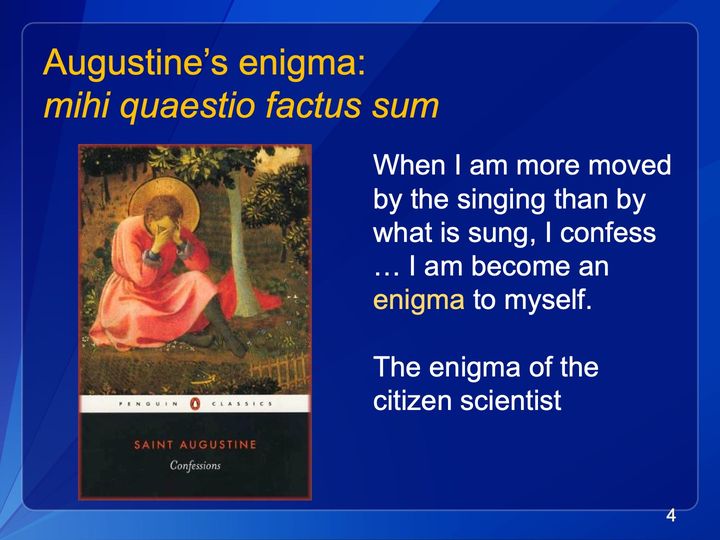
If you look at Augustine’s “quaestio” in context, you see that he is expressing more than self-reflection. He is expressing a tension between the role of spiritual devotion and the possible distraction from that devotion by the sensory delight of hearing the singing of psalms. As I narrate my story this evening, I will explore some possible tensions that arise in Citizen Science. I call it “the enigma of the citizen scientist”.
For now, though, let’s turn back to TB. Before I started working in TB, I knew little about it. So I’m wondering, what do you associate TB with?
[From a translation by Albert C. Outler, 1955 (Confessions 10.33.50):
“When I am more moved by the singing than by what is sung, I confess myself to have sinned wickedly, and then I would rather not have heard the singing. … But do thou, O Lord, my God, give ear; look and see, and have mercy upon me; and heal me—thou, in whose sight I am become an enigma to myself; this itself is my weakness.”]
Abbreviations: TB = tuberculosis.
TB has plagued humanity for millennia and into the present. As recently as the 19th and 20th centuries, TB was a prominent cause of death – making up as much as a quarter of European deaths. This pattern persisted and became exacerbated in part because there was no effective treatment and in part because of increasing concentration of the populace into urban centers with poor sanitary conditions.
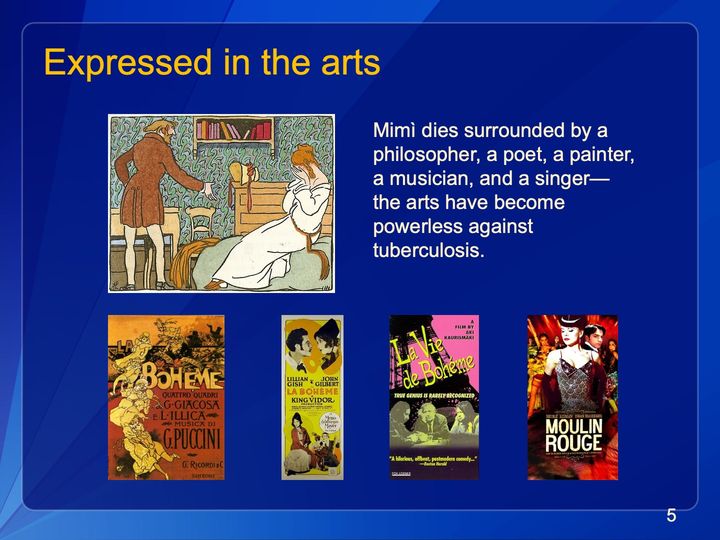
The arts preserve several dimensions of human encounters with TB, through many media: literature, drama, opera, painting, song, cinema. Thomas Mann (novel), John Le Carre (novel), Edvard Munch (painting), Van Morrison (song), Jimmie Rodgers (song), Eugene O’Neill (drama).
The grandmother of TB in fictional narrative is Henry Murger’s fictional Scènes de la vie de bohème in France in 1851. This collection of stories became the basis of Puccini’s opera La bohème in 1896 and Baz Luhrmann’s film Moulin Rouge! In 2001, among other later works.
In discussing the place of Puccini’s La bohème in the history of TB, one observer wrote, “Mimì dies surrounded by a philosopher, a poet, a painter, a musician, and a singer—the arts have become powerless against tuberculosis.” Let’s see whether science can overcome what the arts could not.
[“Mimì dies” quotation on pg 1355 of DM Morens. At the deathbead of consumptive art. Emerging Infectious Diseases. 2002; 8(11): 1353–1358. Image credits Wikipedia.
See also http://en.wikipedia.org/wiki/Tuberculosis_in_popular_culture.]
Abbreviations: TB = tuberculosis.
Let’s move back in time to set the historical context for TB.
[Quotation from Mario Raviglione, Director, WHO Stop TB Department, on page 6 of The Global Plan to Stop TB: 2011–2015.]
Abbreviations: TB = tuberculosis; WHO = World Health Organization.
Text in the picture
Main symptoms of
Pulmonary tuberculosis
Central
- appetite loss
- fatigue
Lungs
- chest pain
- coughing up blood
- productive,
prolonged cough
Skin
- night sweats,
- pallor
[cut off] Magn Det WD Exp
15549x SE 7.4 0 jhc
2 µm
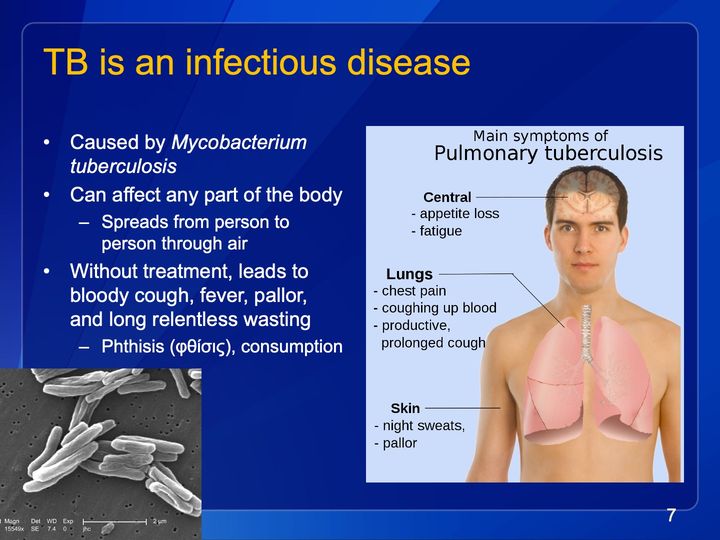
TB is a disease caused by a rod-shaped bacterium, called Mycobacterium tuberculosis. Mtb was established as the causative agent of TB in 1882 in groundbreaking work that also articulated a systematic framework for establishing the microbial causes of disease.
The disease can affect any part of the body, but it spreads from person to person through the air. For this reason, we often focus on TB in the lungs, also called pulmonary TB. Without treatment, TB infection leads to a variety of symptoms, which might include loss of appetite, fatigue, chest pain, bloody cough, prolonged cough, fever, night sweats, and wasting. This last symptom, wasting, gave TB its earlier names – phthisis and consumption – terms now mostly confined to the past.
[Credits: Electron microscope image, CDC; symptoms, Wikipedia]
Abbreviations: CDC = Centers for Disease Control and Prevention; Mtb = Mycobacterium tuberculosis (the bacterium that causes TB); SE = standard error; TB = tuberculosis.
A person with latent TB infection
Has no symptoms and does not feel sick
Cannot spread TB bacteria to others
Needs treatment for latent TB infection to prevent active TB disease (standard: 1 drug daily for 6 months or longer)
> 2 billion infected; 1 in 3 worldwide
5–10% of HIV– lifetime → TB disease; 5–10% HIV+/year → TB disease
A person with TB disease
Usually has symptoms and feels sick
Can spread TB bacteria to others
Needs treatment to treat active TB disease (standard: 4 drugs, 2 to 7 times per week for 6 months or longer)
14 million cases in 2009; 1.7 million deaths (1.3 million [corrected: HIV–], 0.4 HIV+)
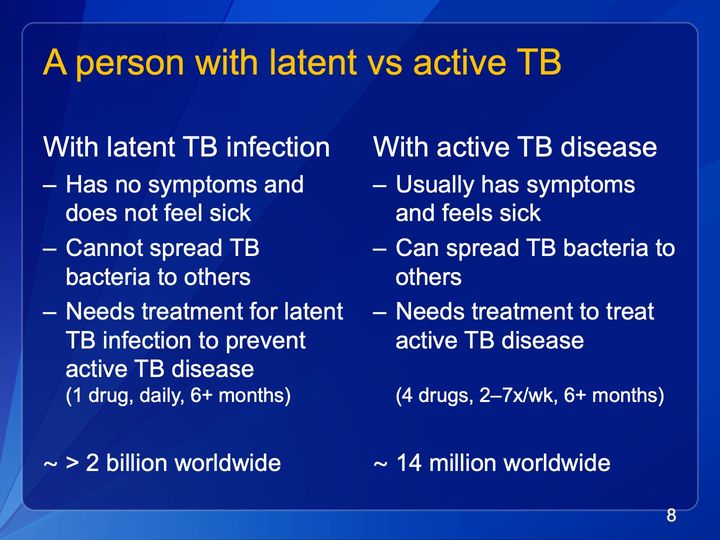
The first effective anti-TB drug, streptomycin, came about in the 1940s. The promise of this first drug was undermined, however, by the development of drug resistance. That is, some TB germs were not affected by streptomycin, and these germs outgrew the others, almost as if the TB hadn’t been treated at all. But by the end of the 1960s, we had a therapy that was effective against over 90% of TB cases. To avoid problems with drug resistance, and to achieve lasting cure, this therapy requires taking several drugs for 6 months or more.
Abbreviations: HIV = human immunodeficiency virus; HIV+ = HIV-positive; TB = tuberculosis.
Text in the picture
TB IS PREVENTABLE & CURABLE
NO
MORE PEOPLE
LIVING WITH HIV
DYING OF TB
UNAIDS [illegible]
World Health Organization
NO
MORE PEOPLE
LIVING WITH HIV
DYING OF TB
World Health Organization
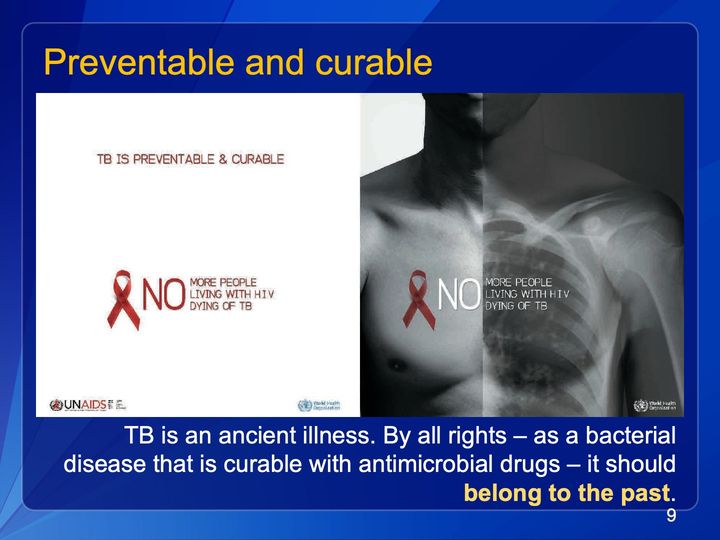
For the past few decades, we have been able to say that TB is preventable—for example, through treating latent TB infection—and curable—through treating active disease. My work in clinical trials is aimed at finding treatments that are simpler and safer.
But it is reasonable to ask, if TB can be cured, then why is it still around? Smallpox has been eradicated. Polio, measles, mumps, rubella are largely in check. The director of the World Health Organization’s Stop TB Department has observed, “TB is an ancient illness. By all rights – as a bacterial disease that is curable with antimicrobial drugs – it should belong to the past.”
As I will show you, it doesn’t belong to the past. To the contrary, TB has reemerged in recent decades.
[Image credit WHO. Quotation from Mario Raviglione, Director, WHO Stop TB Department, on page 6 of The Global Plan to Stop TB: 2011–2015.]
Abbreviations: HIV = human immunodeficiency virus; TB = tuberculosis; UNAIDS = Joint United Nations Programme on HIV/AIDS; WHO = World Health Organization.
- Panels
- 1
- Elements
- 1 line depicts new cases (thousands) by year; its last point is circled in yellow
- Horizontal
- 1975 to 2010, ticks every 5 years; the line ends at about 1984, leaving about 3 quarters of the extent empty
- Vertical
- 0 to 35, ticks every 5; the line stays between about 22 and 34, so the lower 60% of the extent is empty
- Visible pattern
- The line decreases from about 34 in 1975 to about 22 in 1984, where it stops..
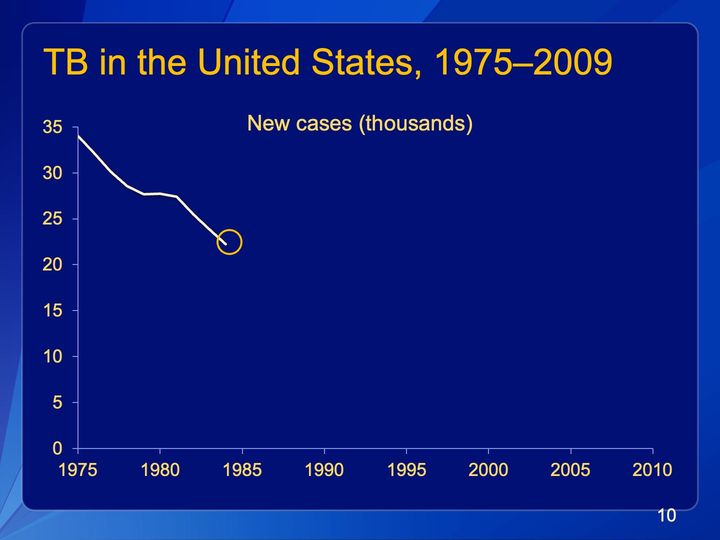
Since the US started keeping count in 1953, the number of new TB cases each year has declined steadily from 84 thousand new cases in 1953, to 34 thousand in 1975, to 22 thousand new cases in 1984.
[Credits: CDC TB surveillance]
Abbreviations: CDC = Centers for Disease Control and Prevention; TB = tuberculosis; US = United States.
- Panels
- 1
- Elements
- 1 line depicts new cases (thousands) by year; 2 points circled in yellow; a magazine cover image sits over the right part of the plot area
- Horizontal
- 1975 to 2010, ticks every 5 years; the line ends at about 1992
- Vertical
- 0 to 35, ticks every 5; the line stays between about 22 and 34
- Visible pattern
- The line falls from about 34 at 1975 to a low near 22 around 1984, stays roughly level until about 1988, then rises to about 27 at 1992, where it stops.
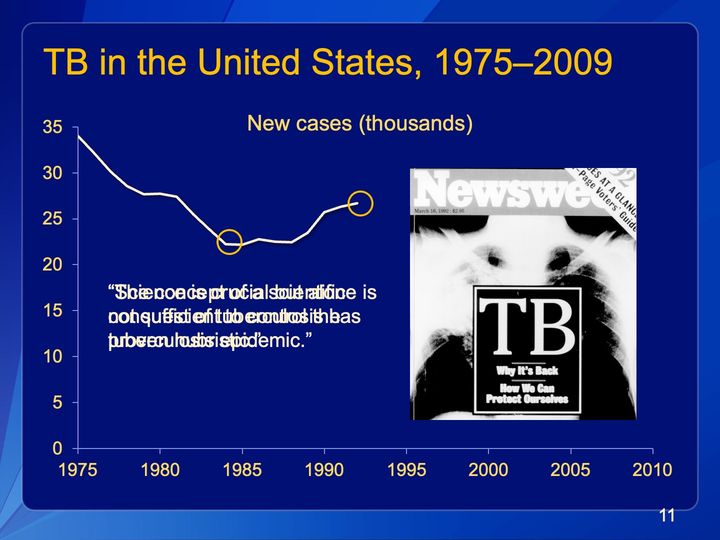
But after 1984, something happened. The number of new cases flattened out for a few years and increased again until it peaked in 1992 – nearly 27 thousand new cases. TB reemerged for many reasons, among them: the HIV epidemic, the development of multidrug resistance, migration into the US of persons from higher-incidence countries, and complacency leading to neglect of the public health infrastructure and TB control programs. The scientific advances that identified Mtb and its cure were not enough. TB needs a steady commitment of political will.
Following this sort of systemic failure, it has bee said, “The concept of a scientific conquest of tuberculosis has proven hubristic.” [Iseman] Another author has written, “Science is crucial but alone is not sufficient to control the [XDR] tuberculosis epidemic.”
[“Concept of scientific conquest” quotation from pg ix of MD Iseman. A Clinician's Guide to Tuberculosis. Lippincott Williams & Wilkins, 2000.
“Science is crucial” quotation from pg 426 of GB Migliori et al. 125 years after Robert Koch’s discovery of the tubercle bacillus: the new XDR-TB threat. Is ‘‘science’’ enough to tackle the epidemic? European Respiratory Journal. 2007; 29: 423–427. The authors add: Basic science plus sound public health approach to use and preserve utility of scientific advances.
Credits: CDC TB surveillance; CDC’s Public Health Image Library]
Abbreviations: CDC = Centers for Disease Control and Prevention; HIV = human immunodeficiency virus; Mtb = Mycobacterium tuberculosis (the bacterium that causes TB); TB = tuberculosis; US = United States; XDR = extensively drug-resistant.
- Panels
- 1
- Elements
- 1 line depicts new cases (thousands) by year; 3 points circled in yellow
- Horizontal
- 1975 to 2010, ticks every 5 years; the line ends at about 2009
- Vertical
- 0 to 35, ticks every 5; the line never drops below about 11, so roughly the lower third is empty
- Visible pattern
- The line falls from about 34 at 1975 to a low near 22 in the mid-1980s, stays roughly level until the late 1980s, rises to a peak near 27 around, and falls steadily to about 12 by 2009.
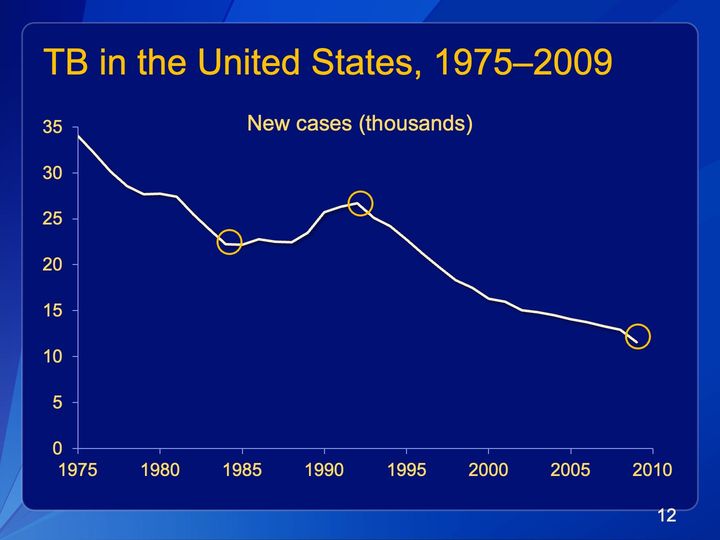
With concerted effort and investment in the public health infrastructure, the trend has been descending for the past 17 years, down to under 12 thousand new cases. With even these steady declines, it is expected to be decades before TB is eliminated from the US.
Many of the same factors that fueled the reemergence of TB in the US also fuel the global pandemic: HIV, drug resistance, and political neglect.
[Credits: CDC TB surveillance]
Abbreviations: CDC = Centers for Disease Control and Prevention; HIV = human immunodeficiency virus; TB = tuberculosis; US = United States.
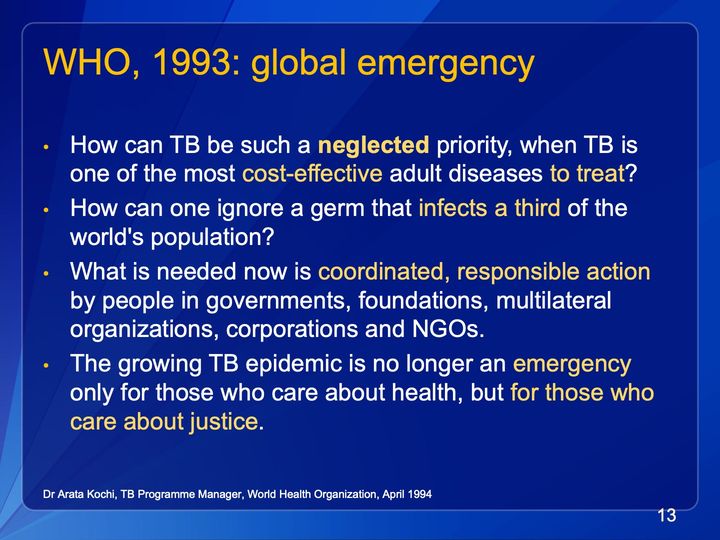
Around the time that TB peaked in the US, the global picture was no better. In April 1993, the World Health Organization declared TB a global emergency and one of the world's most neglected health crises.
Neglect. The WHO TB program manager went on:
How can TB be such a neglected priority, when TB is one of the most cost-effective adult diseases to treat?
How can one ignore a germ that infects a third of the world's population?
Who would refuse to spend $30-the cost of TB medicines in many countries-to save this human life?
What is needed now is coordinated, responsible action by people in governments, foundations, multilateral organizations, corporations and NGOs who can finance and implement more TB treatment programmes.
The growing TB epidemic is no longer an emergency only for those who care about health, but for those who care about justice.
[Dr Arata Kochi, TB Programme Manager, World Health Organization, April 1994; WHO/TB/94.177]
Abbreviations: NGOs = nongovernmental organizations; TB = tuberculosis; US = United States; WHO = World Health Organization.
- Panels
- 1
- Elements
- World map choropleth with 6 legend classes; small island countries shown as circles at the map margins
- Horizontal
- Longitude, the whole world from the Americas at the left to the Pacific islands at the right; legend in the lower middle, over the Indian Ocean
- Vertical
- Latitude, from the Arctic to the southern tips of South America and Africa; Antarctica not shown
- Visible pattern
- The deepest blue (300 or more) covers a large contiguous block of sub-Saharan Africa, from part of West Africa through central and southern Africa, plus a few countries in mainland Southeast Asia.
Text in the picture
Estimated new TB cases (all forms) per 100 000 population
0–24
25–49
50–99
100–299
≥300
No estimate
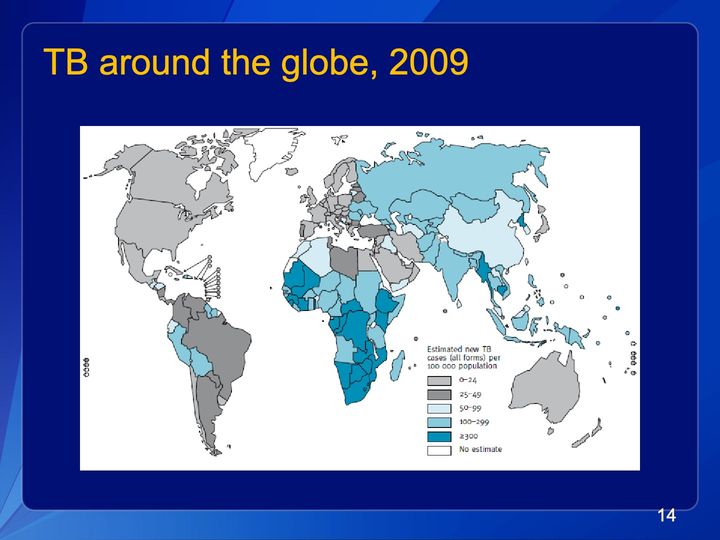
This map shows where TB is concentrated around the globe as of 2009. There were a total of 14 million existing cases, 9.4 [corrected: million] new cases, and 1.7 million deaths.
As shown by the dark cyan and turquoise shading, Africa and Asia bear the largest brunt of this epidemic. (55% of all new cases were in Asia and 30% in Africa.)
12% of new TB cases are in persons who also have HIV; the vast majority with TB/HIV are in Africa.
Abbreviations: HIV = human immunodeficiency virus; TB = tuberculosis.
Text in the picture
CITIZEN
SCIENCE
BARD COLLEGE
...
Beginning Winter 2011
[paragraph not transcribed]
How can we reduce the global burden of infectious disease?
[3 topical rotations]
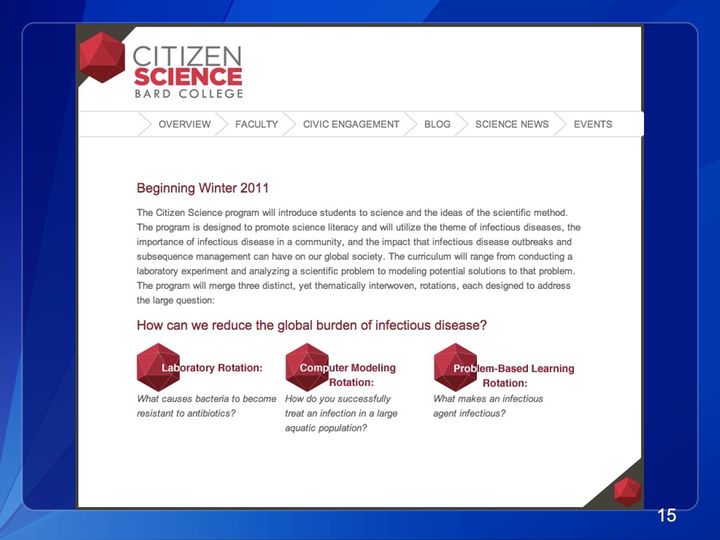
TB is an infectious disease of global importance, so it’s particularly well suited for the inaugural Citizen Science program.
Abbreviations: TB = tuberculosis.
Text in the picture
How can we reduce the global burden of infectious disease?
How can we reduce the global burden of infectious disease?
More specifically, how can we reduce the global burden of TB?
Abbreviations: TB = tuberculosis.
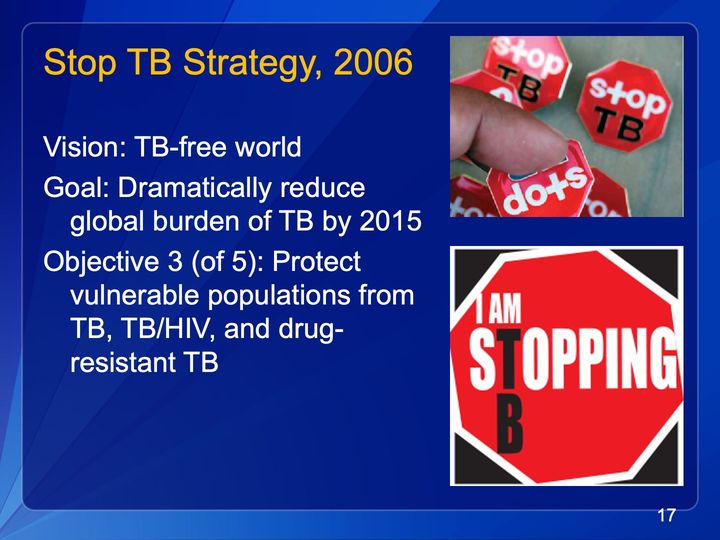
“The Stop TB Partnership was established in 2000 as a global movement to accelerate social and political action to stop the spread of TB around the world. The Partnership’s goal is to eliminate TB as a public health problem and, ultimately, to secure a world free of TB.”
I based the title of my talk on this very phrase.
I’ve mentioned that HIV fuels the TB epidemic. Among new cases of TB in 2009, 12% were in persons living with HIV. One of the Stop TB Partnership’s specific objectives is to protect vulnerable populations from TB/HIV. I will focus on this important group for the remainder of my presentation.
[Quotation from Marcos Espinal, Executive Secretary, Stop TB Partnership, on page 5 of The Global Plan to Stop TB: 2011–2015.
Graphics from WHO and Becton-Dickinson.]
Abbreviations: HIV = human immunodeficiency virus; TB = tuberculosis; WHO = World Health Organization.
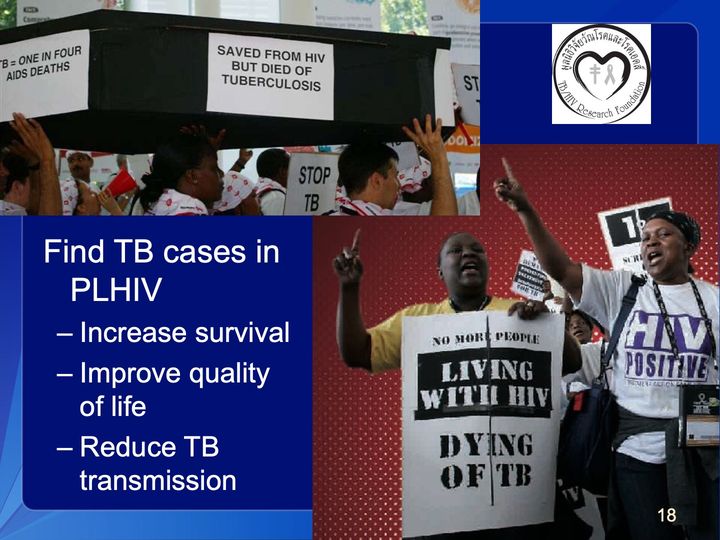
Although only 1 in 8 new cases of TB in is a person living with HIV, this is an important group to focus on. A person with both latent TB infection is substantially more likely to progress to active disease if she also has HIV. And a person with HIV is also less able to fight and control active disease, so HIV increases risk of TB and TB-related death. In fact, TB is the leading cause of death among persons with HIV. In 2009, almost 400 thousand HIV deaths were caused by TB – over one fifth of all TB deaths.
Historically, HIV programs and TB programs have operated separately. It’s important for these programs to work together to find cases of TB among persons with HIV, so that those who don’t have TB can work to prevent it and those who do have it can work to cure it. This will increase survival, improve quality of life, and reduce TB transmission.
[Graphics: WHO]
Abbreviations: HIV = human immunodeficiency virus; PLHIV = people living with HIV; TB = tuberculosis; WHO = World Health Organization.
It seems obvious, doesn’t it? But until recently, not a lot was known about efficient ways to find out who has TB on a large scale. In fact, this question of finding TB efficiently has been rated as one of the most important research questions by world leaders in the efforts to stop TB – 9.6-on-a-scale-of-10 important.
[Source: Priority research questions for tuberculosis/human immunodeficiency virus (TB/HIV) in HIV-prevalent and resource-limited settings. WHO/HTM/TB/2010.8.
Highest rated question for TB prevention (9.6/10): “What is the optimal TB screening algorithm to be used across different settings, with different TB and HIV disease burden, to safely initiate preventive TB therapy?” [page 10]
Second-highest rated question regarding intensified case-finding (9.1/10): “What is the optimal TB screening and diagnostic algorithm for use across all settings with different HIV and TB disease burdens to enable screening of all forms of TB, and that can be integrated into routine care?” [page 14]]
Abbreviations: HIV = human immunodeficiency virus; TB = tuberculosis; WHO = World Health Organization.
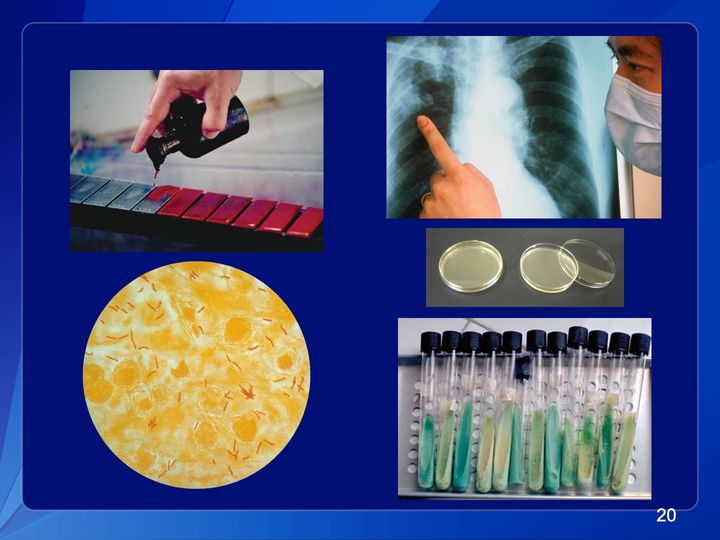
This slide depicts some of the most direct ways of finding TB of the lungs.
On the upper right, a health care worker reviews a chest x-ray for evidence of scar tissue. This is an indirect method, because it looks for signs of damage rather than for the bug itself. It is also good but not great at figuring out who really has TB. In particular, it doesn’t work as well in persons who have HIV.
The other pictures show methods for looking for the Mtb bug itself. First, a patient coughs up sputum—which can be indelicately described as hocking up a loogie—and this sputum specimen is prepared for examination. On the left, a specimen is smeared on a slide and treated with chemicals, including a red dye. Seen under a microscope, the reddish rods are the so-called “acid-fast bacilli” (or AFB), indicating Mtb-like bacteria. A smear result can be available within hours of sputum production, but its accuracy is not perfect, especially in persons living with HIV. On the lower right are 2 examples of using culture media. The prepared sputum is placed on a nutrient-rich substance and warmed until enough bacteria grow to be detected. The culture method can take 6 weeks and requires specialized equipment and training, and it is currently considered the most reliable way to detect Mtb when it is present.
There are other tools for detecting the Mtb bug, but these are the most important for my story here. All of these tools require specialized equipment and training.
[Image credits WHO]
Abbreviations: AFB = acid-fast bacilli; HIV = human immunodeficiency virus; Mtb = Mycobacterium tuberculosis (the bacterium that causes TB); TB = tuberculosis; WHO = World Health Organization.
- Panels
- 1
- Elements
- flowchart of 3 rounded boxes, 1 diamond decision and 2 rounded labels (No, Yes), joined by 3 arrows
- Horizontal
- start box and decision centered; the No branch at left, the Yes branch at right
- Vertical
- 3 levels: start box at top, decision in the middle, 2 treatment boxes at the bottom
- Visible pattern
- A single arrow runs down from the start box to the diamond. From the diamond's left point an arrow curves down to the preventive-treatment box, with No beside it; from its right point an arrow curves down to the curative-treatment box, with Yes beside it.
Text in the picture
Person living with HIV
Does s/he have Mtb+ culture?
No
Yes
Use preventive treatment
Use curative treatment
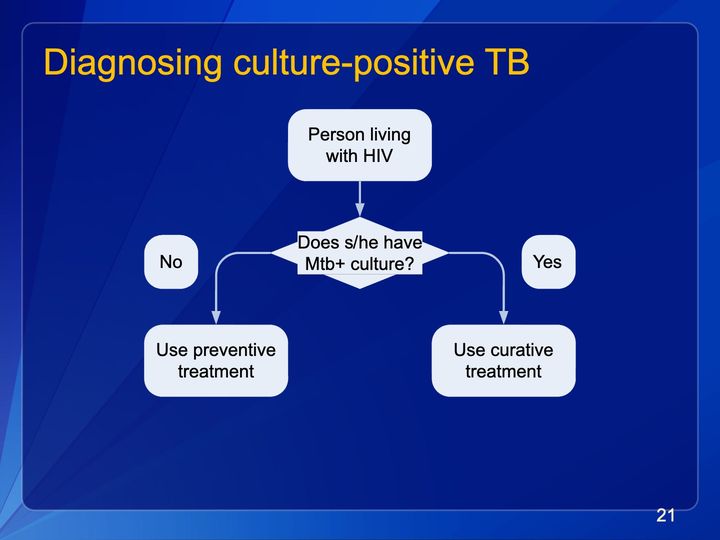
If you could do an Mtb culture on everyone, then you could find virtually all the Mtb there is to find. Let’s draw a decision rule, as shown in this flow diagram. You’re a doctor in a developing country, and you’re treating a person who has HIV. You want to know whether she also has TB. You could have her produce a sputum specimen (that is, hock a loogie) that you then send to your lab. 2 months later, you know whether her specimen grew TB (that is, a positive culture result on the right) or not (a negative culture result, on the left). If she’s negative, you can administer preventive treatment to ensure that she doesn’t develop TB. If she’s positive, you can administer curative treatment to get rid of her TB.
If culture is the most reliable way of figuring out who has TB and who doesn’t, why not just use it for everyone? First, recall that it takes 6 weeks or more to get a result. That’s valuable time that you want to spend just waiting. Second, culture is resource-intensive, meaning that it requires specialized equipment, materials, and training. All of which are harder to come by in developing countries. So, is there a less resource-intensive way? There is, and it starts with information that is easier to obtain than a culture result.
Abbreviations: HIV = human immunodeficiency virus; Mtb = Mycobacterium tuberculosis (the bacterium that causes TB); TB = tuberculosis.
- Panels
- 1
- Elements
- flowchart of 3 rounded boxes, 1 diamond decision, 2 rounded labels (No, Yes) and 3 arrows; 1 callout box joined by a bracket; 2 outlined outcome boxes, partly filled white
- Horizontal
- start box and decision centered; the No branch at left, the Yes branch at right; the callout at far right
- Vertical
- 4 levels: start box, decision, the 2 result boxes, and the 2 outcome boxes at the bottom
- Visible pattern
- A single arrow runs down from the start box to the diamond, which branches left (No) to the preventive-treatment box and right (Yes) to the evaluate-further box. A small callout is bracketed to the right of the evaluate-further box. Beneath each result box sits an outcome box: cases missed on the left, resources used on the right.
Text in the picture
Person living with HIV
Does s/he have x symptom(s)?
No
Yes
Use preventive treatment
Evaluate further
For example, Mtb culture
Cases missed
Resources used
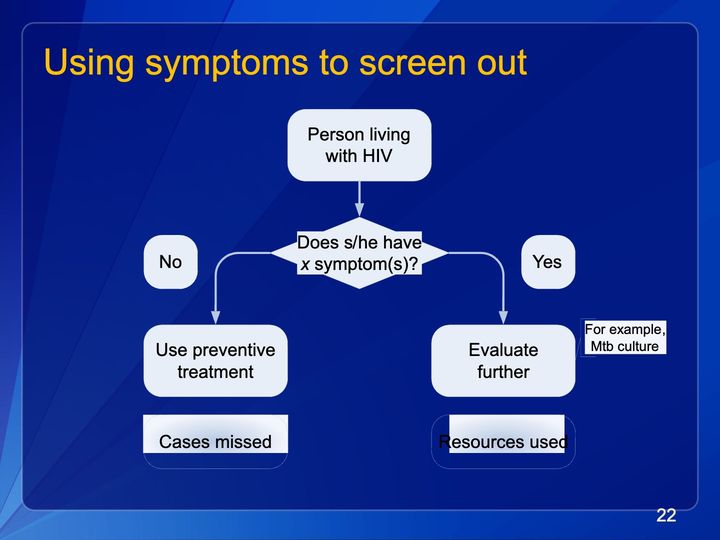
Earlier in this presentation I listed some classic symptoms for TB disease, like prolonged or bloody cough, fever, night sweats, weight loss, and fatigue. The idea of symptom screening is to ask the patient a few questions and then, based on her answers, decide whether she is more or less likely to have TB.
On this diagram, if she screens negative, then you go to the left and consider preventive treatment. If your patient screens positive, then go to the right and consider further evaluation, perhaps using x-ray, smear, or culture. I won’t focus on these further evaluations except to note their role in the tradeoff for resources used: the more we screen out, the fewer evaluations we need.
Now, every decision rule can be right or wrong. It is possible that your patient could have no symptoms but really have TB. I’ll call such a patient a missed case. My story today focuses on ruling out TB and getting people into preventive treatment, so we want to do what we can to avoid missed cases.
Abbreviations: HIV = human immunodeficiency virus; Mtb = Mycobacterium tuberculosis (the bacterium that causes TB); TB = tuberculosis.
- Panels
- 1
- Elements
- flowchart of 3 rounded boxes, 1 diamond decision, 2 rounded labels (No, Yes) and 3 arrows; 1 callout box joined by a bracket; 2 outlined outcome boxes, partly filled white
- Horizontal
- start box and decision centered; the No branch at left, the Yes branch at right; the callout at far right
- Vertical
- 4 levels: start box, decision, the 2 result boxes, and the 2 outcome boxes at the bottom
- Visible pattern
- The same layout as the symptom flowchart: one arrow down to the diamond, which branches left (No) to the preventive-treatment box and right (Yes) to the evaluate-further box, with a bracketed callout at right. Outcome boxes sit beneath each result box, cases missed on the left and resources used on the right.
Text in the picture
Person living with HIV
Does s/he have cough > 2 wk?
No
Yes
Use preventive treatment
Evaluate further
For example, Mtb culture
Cases missed
Resources used
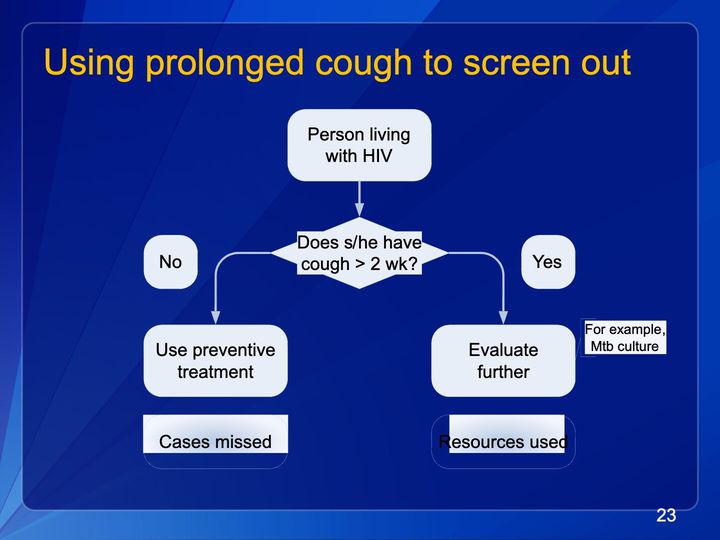
In fact, symptom screening has been used throughout the course of managing TB. Here’s an example of an algorithm that the World Health Organization recommended in 2007. If the patient has a cough of 2 to 3 weeks or more, go right for further evaluation; if not, go left for preventive treatment.
This recommendation was based on expert opinion, meaning that it came from the informed opinions and experience of knowledgeable people, but it did not come from actual data. This leads to an important question: Does this algorithm work well in practice for finding TB? In 2007, this was not well addressed. In fact, this is the most salient scientific feature of my talk: moving from expert opinion to something strong enough to change global guidelines.
[Source: Page 9, Improving the diagnosis and treatment of smear-negative pulmonary and extrapulmonary tuberculosis among adults and adolescents: Recommendations for HIV-prevalent and resource-constrained settings.
Stop TB Department, Department of HIV/AIDS. http://whqlibdoc.who.int/hq/2007/WHO_HTM_TB_2007.379_eng.pdf]
Abbreviations: AIDS = acquired immunodeficiency syndrome; HIV = human immunodeficiency virus; Mtb = Mycobacterium tuberculosis (the bacterium that causes TB); TB = tuberculosis; WHO = World Health Organization.
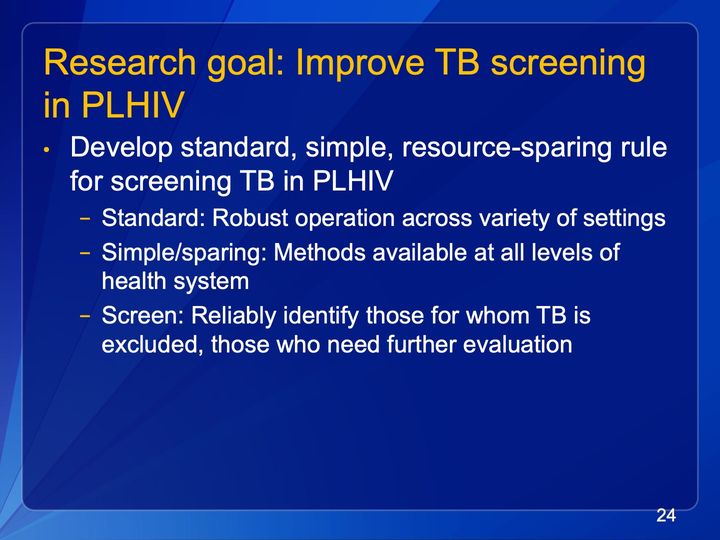
The most reliable and scientific way to check out WHO’s expert-base algorithm is to do a research study. Better yet, you could do a research study that both looks at WHO’s recommended rule and tries to find out whether there is a better rule and what that rule is. What makes one rule better than another?
A good rule will work the same in a variety of settings. For example, it will work well in both Africa and Asia. It will also be feasible to implement with minimal specialized equipment or training. Finally, it should be reliable in screening out persons with HIV who don’t have TB by missing few actual cases.
Abbreviations: HIV = human immunodeficiency virus; PLHIV = people living with HIV; TB = tuberculosis; WHO = World Health Organization.
I’m going to describe just such a research study.
Abbreviations: HIV = human immunodeficiency virus; TB = tuberculosis.
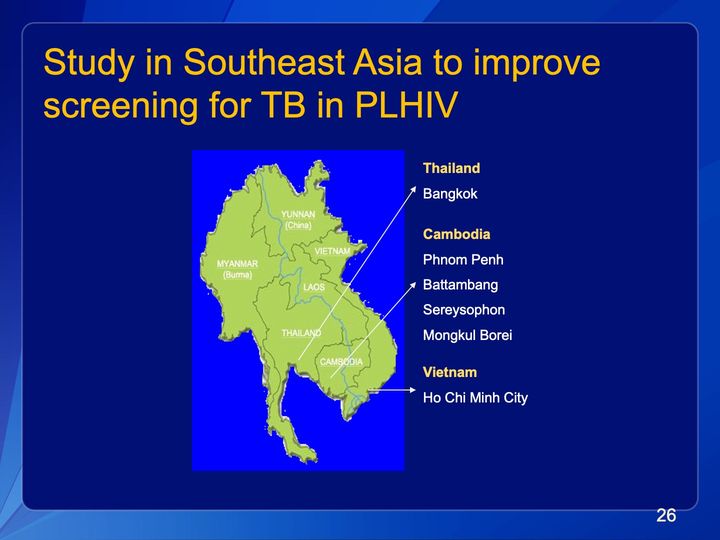
This research study was called Improving Diagnosis of Tuberculosis in Persons Living with HIV. It took place in southeast Asia – specifically, in Thailand, Cambodia, and Vietnam. Recall that TB rates are particularly high in this part of the world, making this a good place to set such a study.
The study started in 2004. I wasn’t involved in the design or execution of the study, but I did design and carry out much of the data analysis, which was published about a year ago in the New England Journal of Medicine.
[See Cain KP, et al. An algorithm for tuberculosis screening and diagnosis in people with HIV. New England Journal of Medicine. 2010; 362(8): 707-716.]
Abbreviations: HIV = human immunodeficiency virus; PLHIV = people living with HIV; TB = tuberculosis.
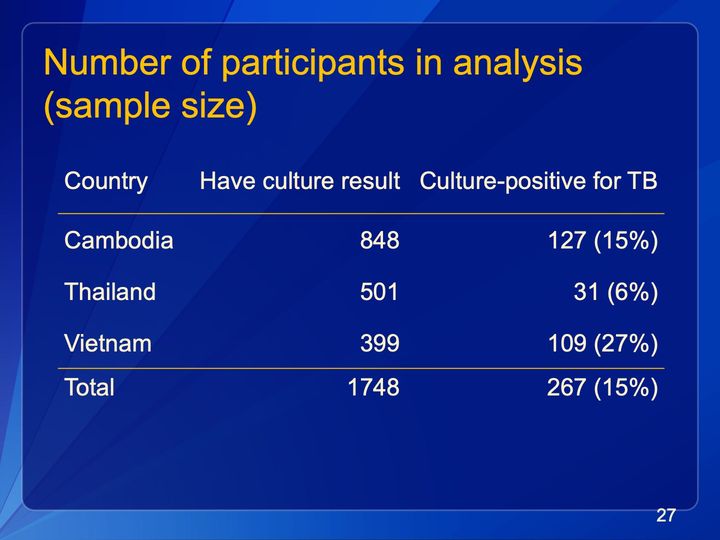
The study enrolled about 2000 participants, but this analysis included 1748 of them. About half were from Cambodia, and the other participants were from Thailand and Vietnam. Overall, about 15% of participants had TB that could be detected by culture.
Abbreviations: TB = tuberculosis.
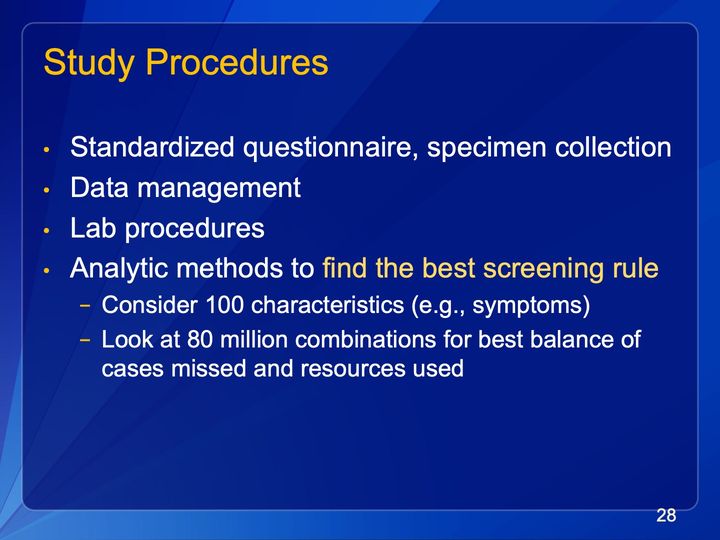
One of the bedrocks of scientific research is the ability to replicate findings. For research in humans, this starts with an explicit research plan. In our study, the plan included a set of standard questions for participants and standard procedures to obtain and process specimens, like sputum. By doing things the same way for each participant, we could increase reliability of our results.
In addition, we followed procedures that ensured that the quality of our results was as high as possible. Similarly, the laboratory procedures ensured that specimens were all processed in the same way according to standard practices.
To find the best screening rule, we considered all possible combinations of 100 different characteristics, including symptoms like cough and fever, but other characteristics like genital ulcers. You wouldn’t expect all the characteristics that we considered to help you in sorting out TB, but a comprehensive analysis ensured that we didn’t miss any useful surprises. We churned through 80 million combinations of these characteristics looking for screening rules that minimized the number of cases missed and resources used in an acceptable way.
Let’s see some actual results.
[Cut comment: Generally, as the number of false negatives goes down, the number of false positives will go off. We had to figure out how to strike the right balance.]
Abbreviations: TB = tuberculosis.
- Panels
- 1
- Elements
- Flowchart: 3 light rounded boxes and 1 diamond joined by arrows, plus 2 small rounded labels holding counts beside the 2 branches
- Horizontal
- 2 branches from the diamond: No to the left, Yes to the right
- Vertical
- 3 tiers, top to bottom: the population box, the question diamond, the 2 treatment boxes
- Visible pattern
- A single box at the top leads by a straight arrow down to the diamond. From the diamond's left and right points, 2 curved arrows bend outward and down, each ending in a box on the bottom tier. the left branch carries the larger count.
Text in the picture
1748 persons
living with HIV
Does s/he have
Mtb+ culture?
1481
No
267
Yes
Use preventive
treatment
Use curative
treatment
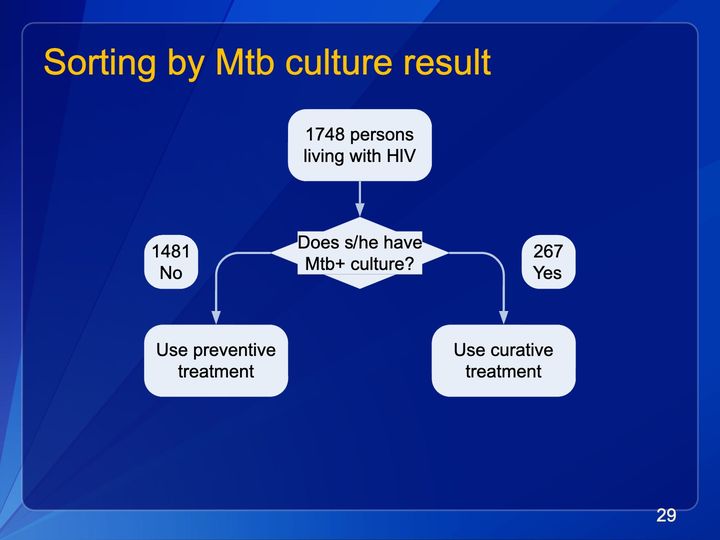
First, as I showed in a previous table, 267 of our participants had evidence of Mtb on culture, and 1481 did not.
Using culture alone to find TB would be a very resource-intensive.
Abbreviations: HIV = human immunodeficiency virus; Mtb = Mycobacterium tuberculosis (the bacterium that causes TB); TB = tuberculosis.
- Panels
- 1
- Elements
- Flowchart: 3 light rounded boxes and 1 diamond joined by arrows; 2 small rounded labels holding counts beside the branches; a small rectangular callout joined by a thin line to the right-hand box; 2 outcome boxes below the bottom tier, not joined by arrows, each with a white fill that fades out over its lower part
- Horizontal
- 2 branches from the diamond: No to the left, Yes to the right
- Vertical
- 4 tiers, top to bottom: the population box, the question diamond, the 2 action boxes, the 2 outcome boxes
- Visible pattern
- The layout is the same as the preceding culture flowchart: one box at the top, a straight arrow down to the diamond, and 2 curved arrows bending left and right down to the action boxes. Here the left branch carries the larger count. Beneath each action box sits an outcome box: missed cases with a count and percentage on the left, and a question mark for resources used on the right. The callout sits at the upper right of the right-hand action box.
Text in the picture
1748 persons
living with HIV
Does s/he have
cough > 2 wk?
1393
No
335
Yes
Use preventive
treatment
Evaluate
further
For example,
Mtb culture
179 (67%)
Cases missed
?
Resources used
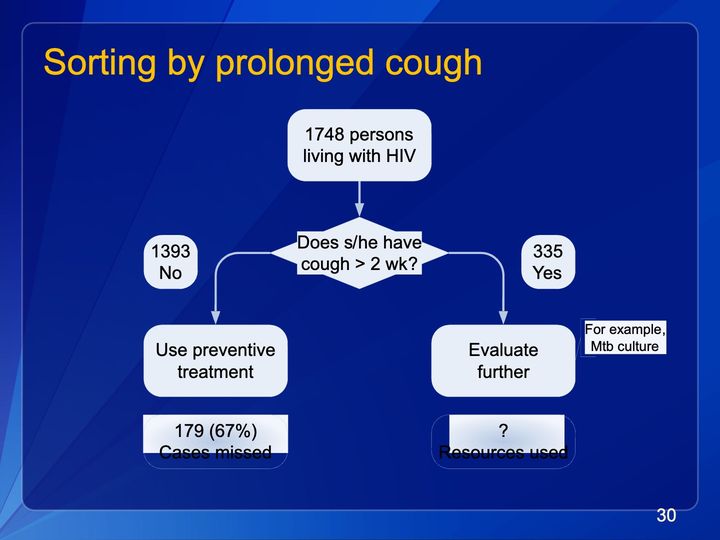
When we use the screening criterion from WHO’s 2007 guidelines – cough for longer than 2 weeks – we see that 335 of our participants reported this symptom, and 1393 did not. Among those that would screen as negative, 179 are culture-positive. That’s 67% of all the participants who have Mtb+ cultures, all of whom would be put on preventive rather than curative therapy under this rule. It would be good to bring down the missed-case rate below 67%.
[Note: Among those who don’t have TB, 82% have a negative screen.]
Abbreviations: HIV = human immunodeficiency virus; Mtb = Mycobacterium tuberculosis (the bacterium that causes TB); TB = tuberculosis; WHO = World Health Organization.
- Panels
- 1
- Elements
- Flowchart: 3 light rounded boxes and 1 diamond joined by arrows; 2 small rounded labels holding counts beside the branches; a small rectangular callout joined by a thin line to the right-hand box; 2 outcome boxes below the bottom tier, not joined by arrows, each with a white fill that fades out over its lower part
- Horizontal
- 2 branches from the diamond: No to the left, Yes to the right
- Vertical
- 4 tiers, top to bottom: the population box, the question diamond, the 2 action boxes, the 2 outcome boxes
- Visible pattern
- The layout is the same as the preceding cough flowchart, with a longer question in the diamond set in smaller type. Here the right branch carries the larger count, the reverse of the preceding slide. The missed-cases box on the left holds a much smaller count and percentage than before; the resources-used box on the right still holds a question mark.
Text in the picture
1748 persons
living with HIV
Has s/he had
cough, fever, or
night sweats > 3 wk?
549
No
1199
Yes
Use preventive
treatment
Evaluate
further
For example,
Mtb culture
18 (7%)
Cases missed
?
Resources used
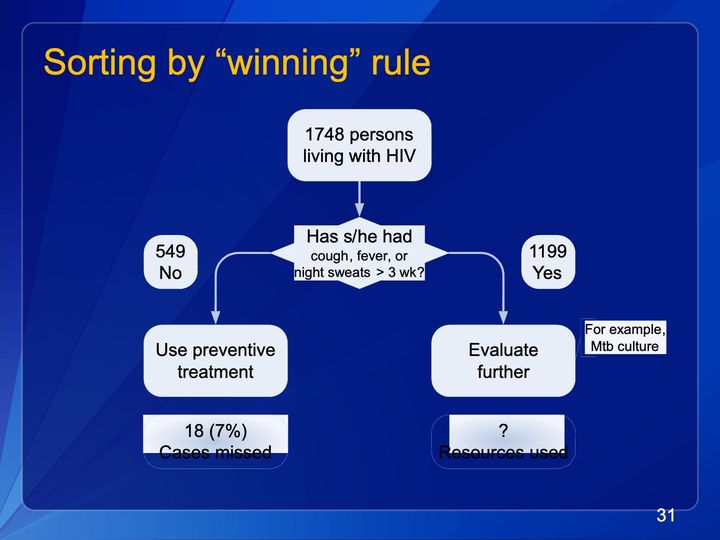
When we churned through our 80 million possible symptom combinations, it turned out that many of them had similar performance. One of the best – the one that we promote in our paper – says to look at a combination of cough, fever, and prolonged night sweats. If your patient has none of these symptoms, she screens negative; if she has any of them, then she should undergo further evaluation. With this rule, only 549 participants screened negative. But among those who screened negative, only 18 actually had Mtb. We brought the missed-case rate down to 7%, using only a symptom screen. It turns out that those 18 Mtb+ participants who screened negative were on average healthier than the Mtb+ participants, which suggests that they did not yet have severe disease.
Abbreviations: HIV = human immunodeficiency virus; Mtb = Mycobacterium tuberculosis (the bacterium that causes TB).
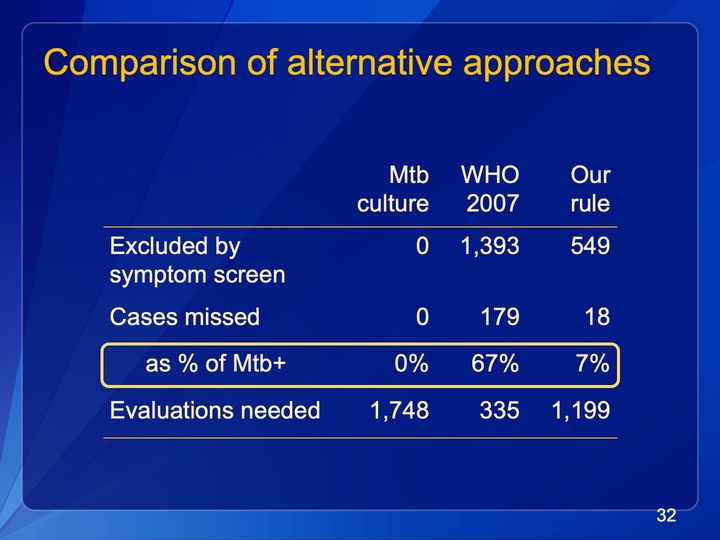
This table shows the results of these 3 algorithms side by side. Using Mtb culture alone doesn’t screen anyone out and doesn’t miss any actual cases, but it requires a culture on everyone. That is not feasible in practice.
The screening rule based on prolonged cough immediately rules out almost 1400 participants, but it misses fully 2/3 of those who actually have Mtb. On the other hand, by requiring only 335 cultures, it is much less resource-intensive.
Finally, our approach screens out 549 people and misses about 7% of those who have Mtb. In addition, it requires further evaluation of about 1200 participants. We did some additional work to make the evaluation of people who screen positive less resource-intensive, but it’s not possible to get entirely away from a substantial investment in equipment and staff.
Because of the rigor in our study across several different scientific disciplines, we produced a high quality of evidence. But it’s still only a single study, which by itself is not quite enough to change global guidelines. To firm up our evidence, you would need to repeat the study and find similar results. That is also expensive.
It is less expensive and nearly as useful to bring together data from multiple studies. That brings us to the next part of my story.
Abbreviations: Mtb = Mycobacterium tuberculosis (the bacterium that causes TB); WHO = World Health Organization.
While we were still in the midst of analyzing the study that I just presented, the World Health Organization commissioned a systematic review of all available evidence about screening for TB among persons with HIV.
Abbreviations: HIV = human immunodeficiency virus; TB = tuberculosis.
This kind of systematic review is called a meta-analysis. The purpose is to combine information from multiple studies in a way that allows you to answer a single question or a small set of questions. We have to do some work to justify combining information in this way, but when it works, it can produce a stronger conclusion than any single study by itself.
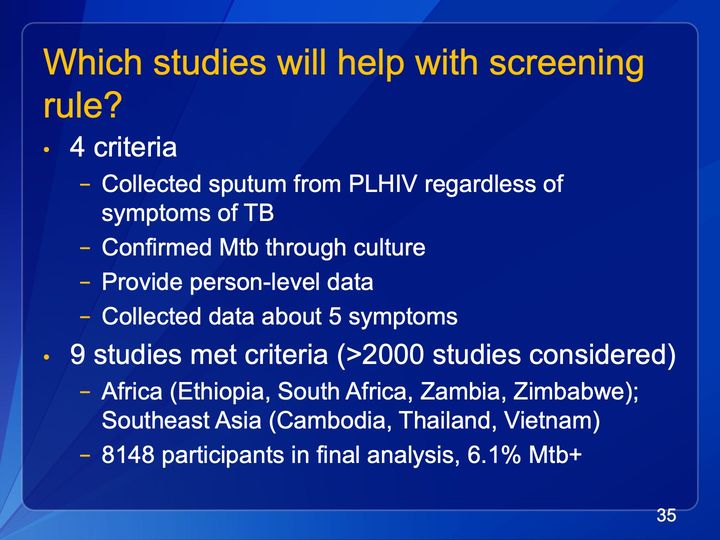
To start out, we needed to figure out which studies might be able to help us find the best screening rule. We settled on these 4 criteria:
The study collected sputum from persons living with HIV, regardless of whether they reported symptoms of TB. This is because we want to be able to generalize to a similar group of people, such as those who present for HIV testing for the first time.
The study confirmed Mtb through culture. This sets a consistent standard for who really does or does not have TB.
The study could provide person-level data. This allowed us to do a richer analysis than if they provided only summary data from each study.
The study collected data about at least 5 symptoms of interest. This allowed us to look at the same candidate screening rules in all the qualifying studies.
A colleague cast the net wide and found over 2000 publications that might lead to such data. With some additional review, this was narrowed down to 9 studies that met our 4 criteria. These studies, which all took place in Africa and Asia, yielded a total of 8148 participants for our analysis. About 6% of them had Mtb+ culture.
Abbreviations: HIV = human immunodeficiency virus; Mtb = Mycobacterium tuberculosis (the bacterium that causes TB); PLHIV = people living with HIV; TB = tuberculosis.
- Panels
- 1
- Elements
- World map choropleth with 6 legend classes; small island countries shown as circles at the map margins; 2 yellow rounded rectangles drawn over the map
- Horizontal
- Longitude, the whole world from the Americas at the left to the Pacific islands at the right; legend in the lower middle, over the Indian Ocean
- Vertical
- Latitude, from the Arctic to the southern tips of South America and Africa; Antarctica not shown
- Visible pattern
- The deepest blue (300 or more) covers a large contiguous block of sub-Saharan Africa, from part of West Africa through central and southern Africa, plus a few countries in mainland Southeast Asia. A large yellow box encloses central, eastern and southern Africa; a smaller yellow box encloses the peninsula of mainland Southeast Asia.
Text in the picture
Estimated new TB
cases (all forms) per
100 000 population
0–24
25–49
50–99
100–299
≥300
No estimate
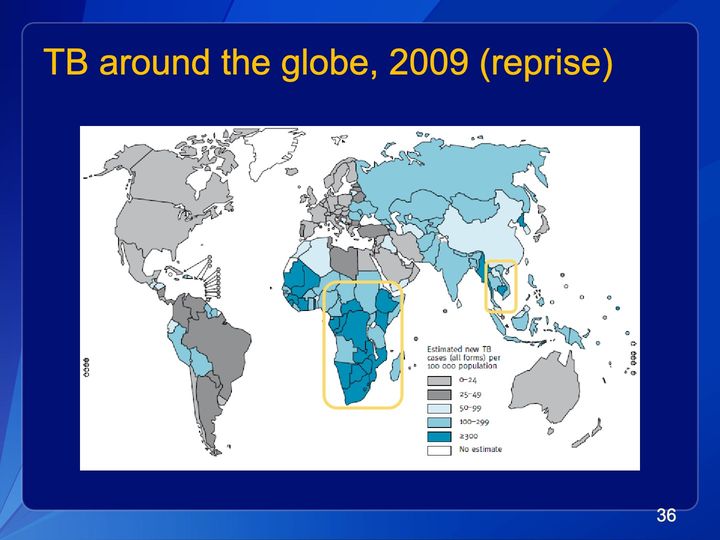
As a quick reminder, the geographic regions in our meta-analysis are among the areas with the highest concentrations of TB, so our results are likely to be broadly useful.
[Map credit: WHO]
Abbreviations: TB = tuberculosis; WHO = World Health Organization.
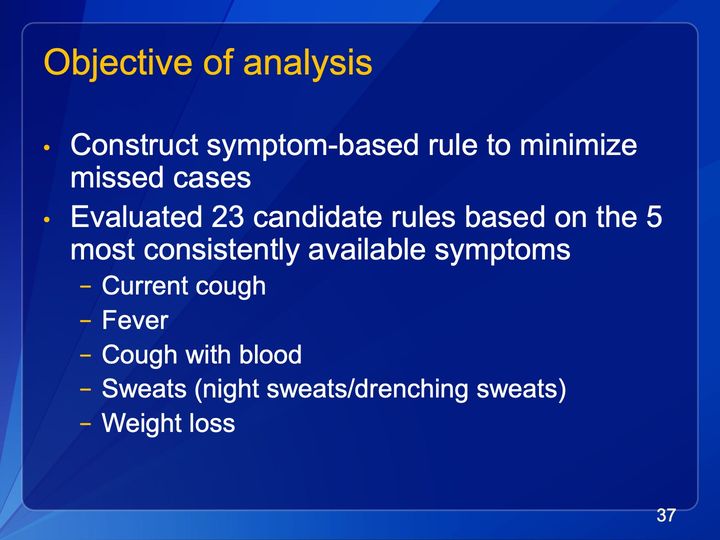
The objective of this analysis was to construct a symptom-based rule that minimizes missed cases, with a particular emphasis on deciding who can safely start preventive treatment. We evaluated 23 candidate rules based on the 5 most consistently available symptoms: current cough, fever, cough with blood, sweats (night sweats/drenching sweats), and weight loss.
Compare this with our Southeast Asia study, where we considered 80 million combinations of 100 characteristics.
- Panels
- 1
- Elements
- Flowchart: 3 light rounded boxes and 1 diamond joined by arrows; 2 small rounded labels (No, Yes) beside the branches, without counts; a small rectangular callout joined by a thin line to the right-hand box; 2 outcome boxes below the bottom tier, not joined by arrows, each with a white fill that fades out over its lower part
- Horizontal
- 2 branches from the diamond: No to the left, Yes to the right
- Vertical
- 4 tiers, top to bottom: the population box, the question diamond, the 2 action boxes, the 2 outcome boxes
- Visible pattern
- The layout repeats the earlier sorting flowcharts, but the population box gives no count and the branch labels hold only No and Yes. The missed-cases box on the left gives a percentage without a count; the resources-used box on the right holds a question mark.
Text in the picture
Persons living
with HIV
Has s/he had
cough, fever, night
sweats, or weight loss?
No
Yes
Use preventive
treatment
Evaluate
further
For example,
Mtb culture
(21%)
Cases missed
?
Resources used
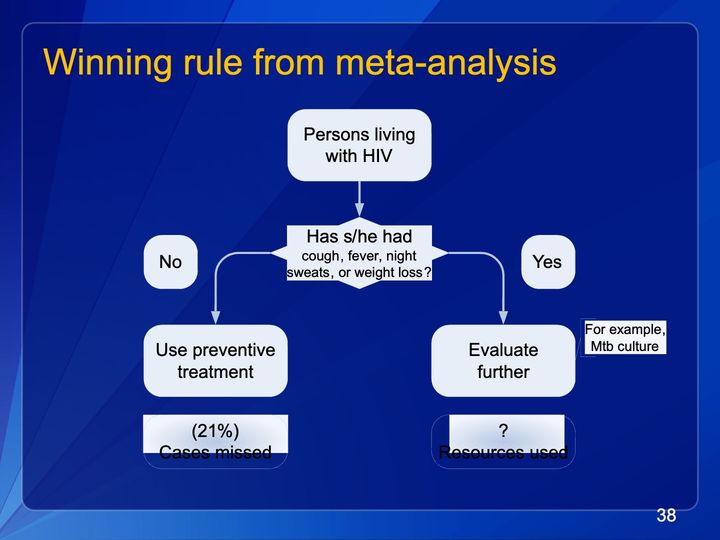
The winning screening rule from the meta-analysis is positive if someone has 1 or more of cough, fever, night sweats, or weight loss; and, it’s negative if they have none of these symptoms.
We estimate that this rule will miss about 21% of people who actually have Mtb, but its benefits outweigh its disadvantages.
Besides being the winning rule in the combined data, this rule minimized missed cases better than the other 22 rules in 8 of the 9 individual studies that we included. This makes us pretty confident that the result will generalize well to a variety of settings.
Abbreviations: HIV = human immunodeficiency virus; Mtb = Mycobacterium tuberculosis (the bacterium that causes TB).
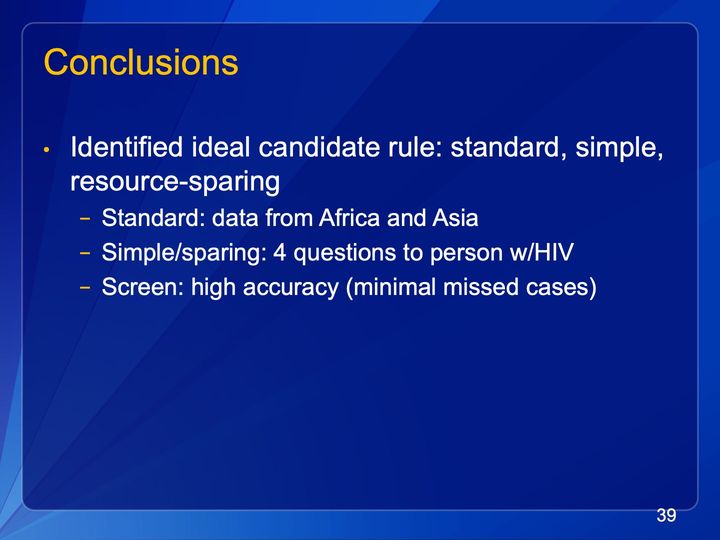
Remember the criteria for our ideal screening rule. We believe that the winning rule from the meta-analysis satisfies these criteria. Because it is a synthesis from several studies, it is based on stronger evidence than the results of any single study, including our study in Southeast Asia.
Standard: Because the data come from several parts of Africa and Asia, this rule is expected to have robust operation across variety of settings.
Simple/sparing: The symptom screen entails posing 4 questions to a patient. Thus, it can be performed with no specialized equipment and very little staff training.
Screen: Because it is based on data from several different studies, it is expected to help reliably identify persons with HIV for whom TB is excluded and those who need further evaluation.
Abbreviations: HIV = human immunodeficiency virus; TB = tuberculosis.
Text in the picture
Guidelines for intensified
tuberculosis case-finding
and isoniazid preventive
therapy for people
living with HIV
in resource-
constrained
settings
World Health
Organization
HIVTB
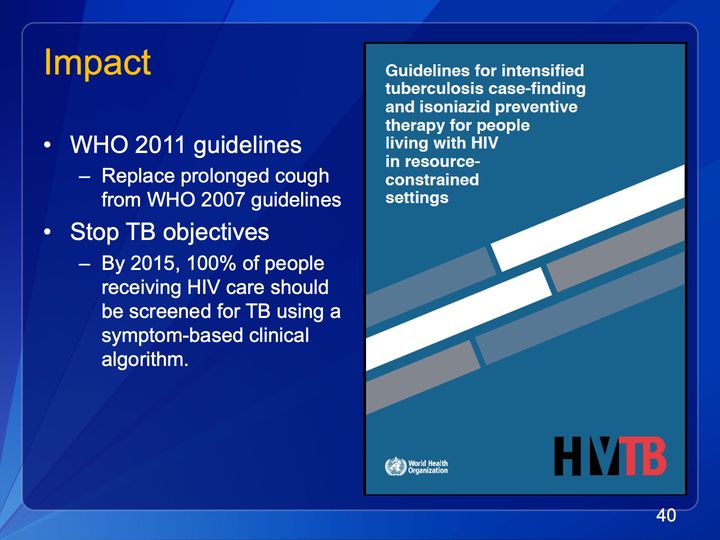
This result is poised to have sizable impact in the effort to stop TB. It has been incorporated into WHO’s 2011 guidelines and the Stop TB Partnership’s latest objectives. Among other changes, it replaces the previous screening rule that used only prolonged cough. With this concrete rule in hand, the Stop TB Partnership has set a goal to have 100% of people receiving HIV care be screened for TB using a symptom-based clinical algorithm.
[Credit: WHO, Stop TB Partnership
Cut: We presented additional evidence (that I did not show here) showing that chest x-ray is not essential for screening; if we had not checked this, there would have been lingering concerns that the new screening rule left out an important step.
Supplemental quotation from HATIP 2010-12-21 newsletter: “What’s new in these 2010 guidelines? One is that screening for TB by using only a symptom-based algorithm is sufficient to start IPT for people living with HIV — and we believe this is based on very solid and thorough evidence and will address much of the anxiety and the concerns of programme managers and implementers,” said Dr Haileyesus Getahun of WHO’s STOP TB Department at the South African TB Conference earlier this year. “Second, there is no need for a chest x-ray and tuberculin skin tests (TST) shouldn’t be a requirement for putting someone on IPT,” he went on. … “The whole focus is not whether somebody has TB, but whether they don’t have TB and whether you can feel safe giving them IPT,” commented Dr Getahun.]
Abbreviations: HATIP = HIV & AIDS Treatment in Practice (newsletter from NAM/aidsmap); HIV = human immunodeficiency virus; HIVTB = human immunodeficiency virus and tuberculosis; IPT = isoniazid preventive therapy; TB = tuberculosis; TST = tuberculin skin test; WHO = World Health Organization.
Abbreviations: TB = tuberculosis.
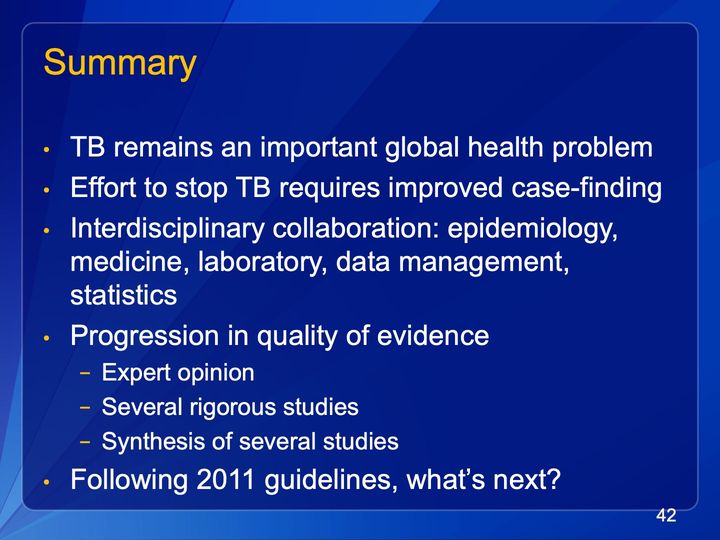
TB remains an important global health problem, and the effort to stop TB requires improved case-finding—among other efforts.
I’ve described a collaboration that spans several scientific disciplines, including epidemiology, medicine, laboratory microbiology, data management, and statistics.
WHO’s 2011 guidelines emerged from a progression of evidence with increasing quality:
First expert opinion, seen as recently as WHO’s 2007 guidelines.
Then several rigorous studies, considered one at a time.
Then a systematic synthesis of information from several studies.
What’s next? As these guidelines are put into practice, it will be important to continue to gather evidence about their effectiveness. Does the rule miss too many cases of TB? Most importantly, do we accelerate the decline in new cases in TB?
In closing out this portion of my talk, I offer a recent reflection from the director of WHO’s Stop TB Department: “The epidemic is in a steady, although modest and slow, decline. … Reducing this human reservoir of infection will require many years of steady and untiring effort – plus more effective tools than we have at our disposal today.”
[Quotation from Mario Raviglione, Director, WHO Stop TB Department, on page 6 of The Global Plan to Stop TB: 2011–2015.]
Abbreviations: TB = tuberculosis; WHO = World Health Organization.
Now I’m going to shift gears and tie the story of finding TB to stop TB back to your experience here at Bard College, Citizen Science, and what drives me as a scientist.
Abbreviations: TB = tuberculosis.
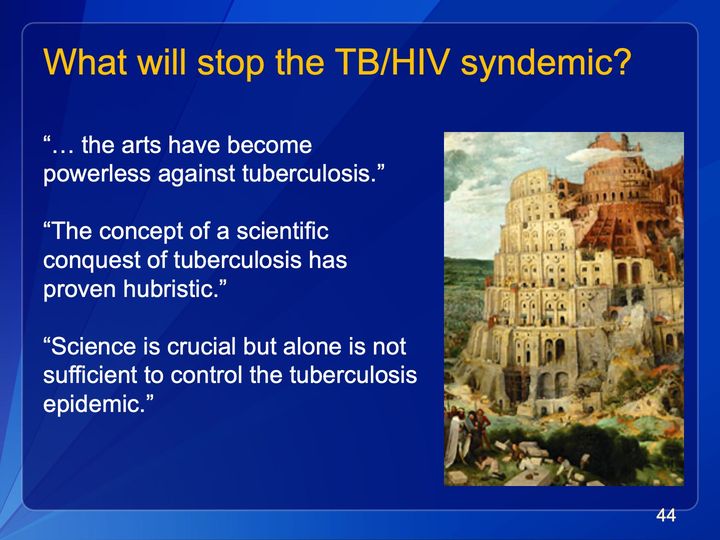
I just showed one real impact of scientific research on global guidelines. But let’s return to the broader question of what it will take to stop the TB/HIV syndemic.
The arts are limited, and the sciences are limited. In the history of TB, we see science that has advanced in fits and starts. It hasn’t been enough to prove what causes TB and how to cure the disease in an individual. The social dimension of TB demands compassion and political will. What is a citizen scientist to do?
[“Science is crucial” quotation from pg 426 of GB Migliori et al. 125 years after Robert Koch’s discovery of the tubercle bacillus: the new XDR-TB threat. Is ‘‘science’’ enough to tackle the epidemic? European Respiratory Journal. 2007; 29: 423–427. The authors add: Basic science plus sound public health approach to use and preserve utility of scientific advances.
“Concept of scientific conquest” quotation from pg ix of MD Iseman. A Clinician's Guide to Tuberculosis. Lippincott Williams & Wilkins, 2000.
Image source: Pieter Bruegel’s The Tower of Babel. See also Bard’s website inside.bard.edu/fys.]
Abbreviations: HIV = human immunodeficiency virus; TB = tuberculosis; XDR = extensively drug-resistant.
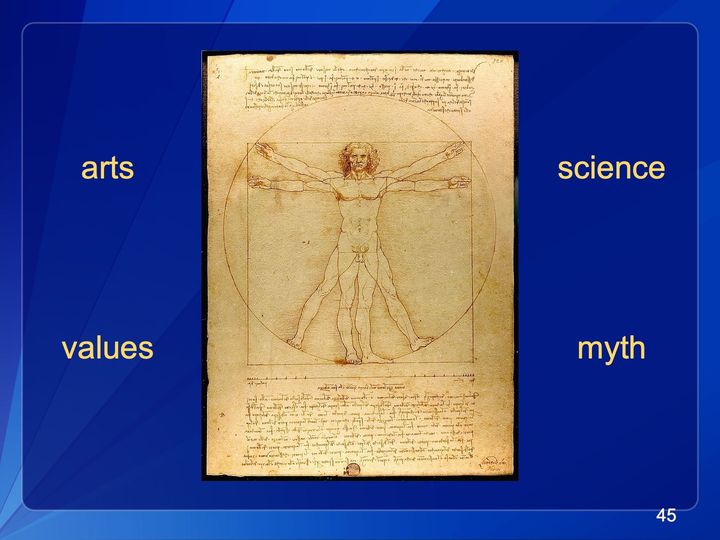
Allow me to offer a personal reflection: I am no artist. It unnerves and embarrasses me to give myself over to artistic expression, perhaps because I focus too narrowly on technical mastery, which I definitely lack. I am a methodologist, trained in math, statistics, some philosophy, a smattering in other disciplines. I derive greater comfort in the realm of reason, where one can measure and count and—paradoxically—quantify uncertainty. I entered public health because I wanted to use rigorous methods to help better the human condition. My personal values motivated me to pursue technical excellence and to offer those skills in public service. In contrast, our culture perpetuates the notion that science is dispassionate and that progress is inevitable. This willful myth allows us to believe that, with the inevitable march of science, humanity will take the upper hand against what threatens or saddens us. How does a scientist, a citizen scientist, resolve the apparent discordance between values and the cultural myth of dispassionate objectivity?
[Image credit Wikipedia: http://en.wikipedia.org/wiki/Vitruvian_Man]
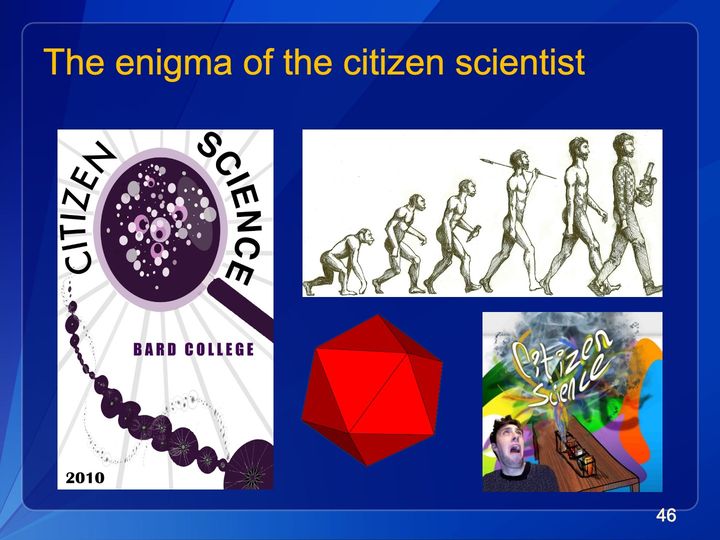
Let’s turn to the enigma of the citizen scientist, who can, I submit, readily resolve the perceived conflict between dispassion and values. The citizen scientist practices a science literacy that acknowledges the tools and power of scientific inquiry and respects their role in how we develop knowledge about the world. As surely as emotion can undermine productive discourse (climate destabilization, anyone?), values also motivate and shape scientific endeavors, and passion itself can fuel scientific pursuits. Not least because TB has shown us that the arts alone, or the sciences alone, will fail against this scourge, will fail to stop TB.
[Image credits: http://citizenscience.bard.edu/blog/?p=181]
Abbreviations: TB = tuberculosis.
Text in the picture
STAND BACK
I'M GOING TO TRY
SCIENCE
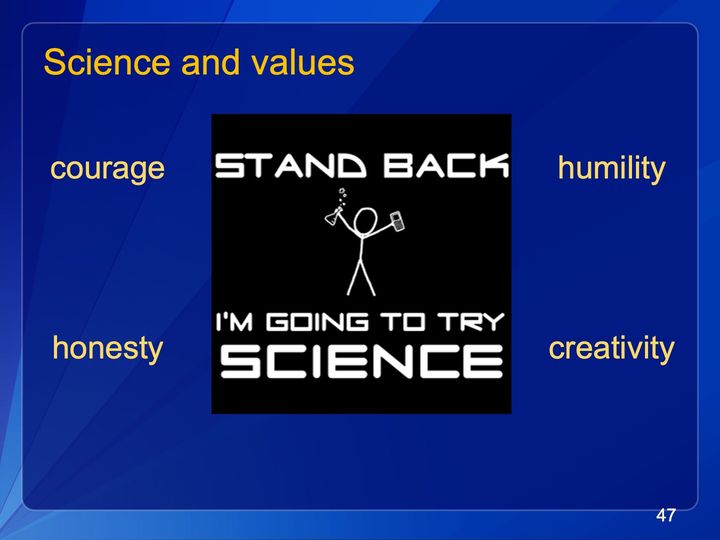
Here are some of the values that animate my own actions:
Courage, both to ask hard questions and to act on difficult answers.
Humility, because it is often possible and even necessary to learn from interesting mistakes.
Creativity, because there’s no formula for telling us which interesting mistake to try to make next.
These values complement the scientific enterprise: the creativity to ask unanticipated questions, the courage to confront difficult questions, and the humility to be open to revising assumptions and knowledge.
I note in passing that these values, at least on the surface, don’t deviate much from what animates the artist.
[Image credit http://imgs.xkcd.com/store/imgs/stand_back_square_0.png]

TB is preventable and curable, and still it’s the leading cause of death among persons with HIV. For decades, public health systems have resisted implementing large-scale efforts to identify who has and doesn’t have TB, despite the knowledge that if you don’t know who has it, you can’t readily interrupt transmission. It took willingness – creativity, courage, and humility – to test the received wisdom against competing alternatives. We have applied scientific principles and obtained evidence patiently, rigorously, and incrementally, first through single studies and then through a systematic synthesis of those studies. On the basis of this evidence, the World Health Organization was able to revise the received wisdom and to promote a workable alternative that stands to help save thousands of lives of persons living with HIV. There are encouraging signs that this evidence-based guidance will be followed by the political will to act.
As for me, I’m grateful to have played a small but substantial role in this one effort to stop TB and better the human condition.
[Image credit Becton-Dickinson]
Abbreviations: HIV = human immunodeficiency virus; TB = tuberculosis.
Text in the picture
DEPARTMENT OF HEALTH & HUMAN SERVICES USA
CDC
Abbreviations: AIDS = acquired immunodeficiency syndrome; CDC = Centers for Disease Control and Prevention; HIV = human immunodeficiency virus; STD = sexually transmitted disease; TB = tuberculosis; USA = United States of America.
Text in the picture
The
Microbial
Challenge
Second
Edition
SCIENCE, DISEASE, AND PUBLIC HEALTH
Robert I. Krasner
I want to acknowledge that you each received an excerpt on TB from Krasner’s text, The Microbial Challenge, pages 428--438. My talk complements Krasner’s treatment, but please feel free to bring it up during discussion this evening or tomorrow.
[Credit: AMS Press.]
Abbreviations: TB = tuberculosis.
Abbreviations
AFB = acid-fast bacilli; AIDS = acquired immunodeficiency syndrome; CDC = Centers for Disease Control and Prevention; HATIP = HIV & AIDS Treatment in Practice (newsletter from NAM/aidsmap); HIV = human immunodeficiency virus; HIV+ = HIV-positive; HIVTB = human immunodeficiency virus and tuberculosis; IPT = isoniazid preventive therapy; Mtb = Mycobacterium tuberculosis (the bacterium that causes TB); NGOs = nongovernmental organizations; PLHIV = people living with HIV; SE = standard error; STD = sexually transmitted disease; TB = tuberculosis; TST = tuberculin skin test; UNAIDS = Joint United Nations Programme on HIV/AIDS; US = United States; USA = United States of America; WHO = World Health Organization; XDR = extensively drug-resistant.
References, compiled for this page
Full citations, with current links, for selected references and related works.
Full references: whole site, by domain (opens in a new tab) · whole site, by type of work (opens in a new tab)
- Cain KP, McCarthy KD, Heilig CM, Monkongdee P, Tasaneeyapan T, Kanara N, Kimerling ME, Chheng P, Thai S, Sar B, et al. An algorithm for tuberculosis screening and diagnosis in people with HIV. New England Journal of Medicine. 2010-02-25; 362(8): 707–716. (slide 26)Elsewhere on the web (opens in a new tab)
- Getahun H, Kittikraisak W, Heilig CM, Corbett EL, Ayles H, Cain KP, Grant AD, Churchyard GJ, Kimerling M, Shah S, et al. Development of a standardized screening rule for tuberculosis in people living with HIV in resource-constrained settings: Individual participant data meta-analysis of observational studies. PLOS Medicine. 2011-01-18; 8(1): e1000391. (slides 33, 48)Elsewhere on the web (opens in a new tab)
- Stop TB Initiative (World Health Organization). Guidelines for intensified tuberculosis case-finding and isoniazid preventive therapy for people living with HIV in resource-constrained settings. Geneva, Switzerland: Department of HIV/AIDS: Stop TB Department, World Health Organization; 2011-01-10. (slides 40, 42)Elsewhere on the web (opens in a new tab)