Data modernization is people: a progressive culture for data in public health
Chad Heilig — Young Professionals Network 9th Annual Conference, 2022-06-28 — 69 slides (63 shown; 6 omitted)
This rendering was constructed from an original PowerPoint presentation. Corrections of original text are indicated as “[corrected: X]”, redactions as “[redacted: X]”, and names withheld as “[generalized: X]”. Handouts and other auxiliary sources mentioned in the presentations are not available. The content of each presentation was believed to be correct and valid at the time of the presentation. This content, including references and links within the slides, has not been checked or updated when preparing this site. This rendering was facilitated by Anthropic Claude agentic tools for automated text extraction through computer vision and for assistance with compiling the completed sets.
Setting: Data modernization is people: a progressive culture for data in public health, 2022-06-28. CDC Young Professionals Network 9th Annual Conference.
Data modernization (small em) is people: culture, workforce, leadership, especially early career. In some ways, this presentation took me back to Bard: As I had wanted to inspire college freshmen in 2011, I wanted to inspire early-career professionals in 2022 to see possibility in values. I had believed for the previous 4 years that the agency’s data modernization rhetoric had overlooked early-career folks. I told them that they should claim roles as co-leaders and assert what they want and need for joining or staying in the public health workforce.
Slide 1Data modernization is people
A progressive culture for data in public health
Young Professionals Network 9th Annual Conference, 2022-06-28
Chad Heilig, PhD • [redacted: email address] Associate Director for Data Science, CSELS
Abbreviations: CDC = Centers for Disease Control and Prevention; CSELS = Center for Surveillance, Epidemiology, and Laboratory Services (CDC); HHS = Department of Health and Human Services.
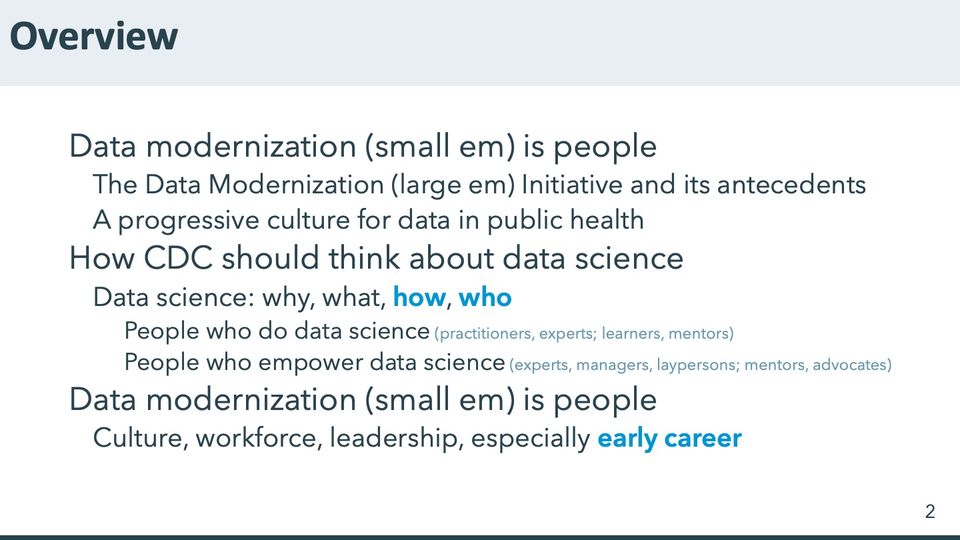
Slide 2Overview
Data modernization (small em) is people
The Data Modernization (large em) Initiative and its antecedents
A progressive culture for data in public health
How CDC should think about data science
Data science: why, what, how, who
People who do data science (practitioners, experts; learners, mentors)
People who empower data science (experts, managers, laypersons; mentors, advocates)
Data modernization (small em) is people
Culture, workforce, leadership, especially early career
Abbreviations: CDC = Centers for Disease Control and Prevention.
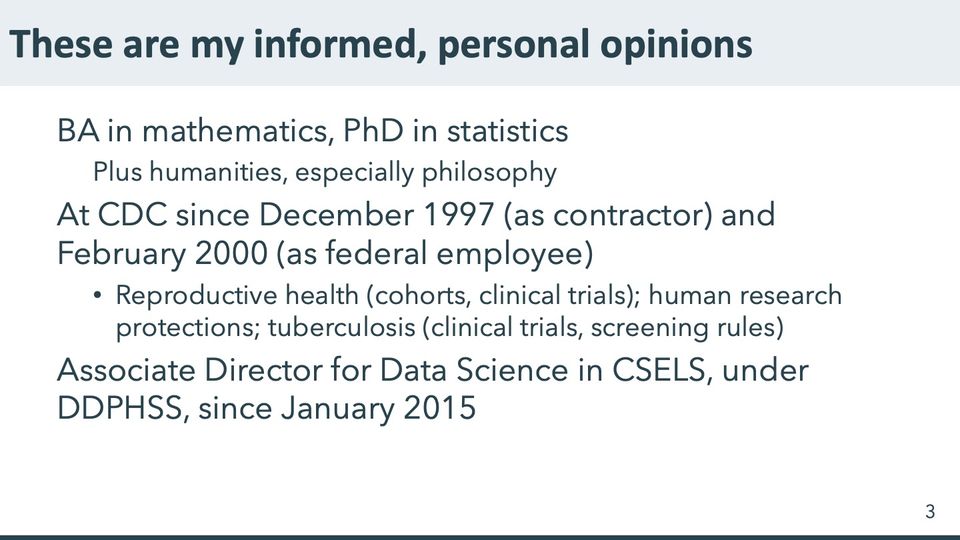
Slide 3These are my informed, personal opinions
BA in mathematics, PhD in statistics
Plus humanities, especially philosophy
At CDC since December 1997 (as contractor) and February 2000 (as federal employee)
Reproductive health (cohorts, clinical trials); human research protections; tuberculosis (clinical trials, screening rules)
Associate Director for Data Science in CSELS, under DDPHSS, since January 2015
Abbreviations: CDC = Centers for Disease Control and Prevention; CSELS = Center for Surveillance, Epidemiology, and Laboratory Services (CDC); DDPHSS = Deputy Director for Public Health Science and Surveillance (CDC).
Slide 4Data modernization
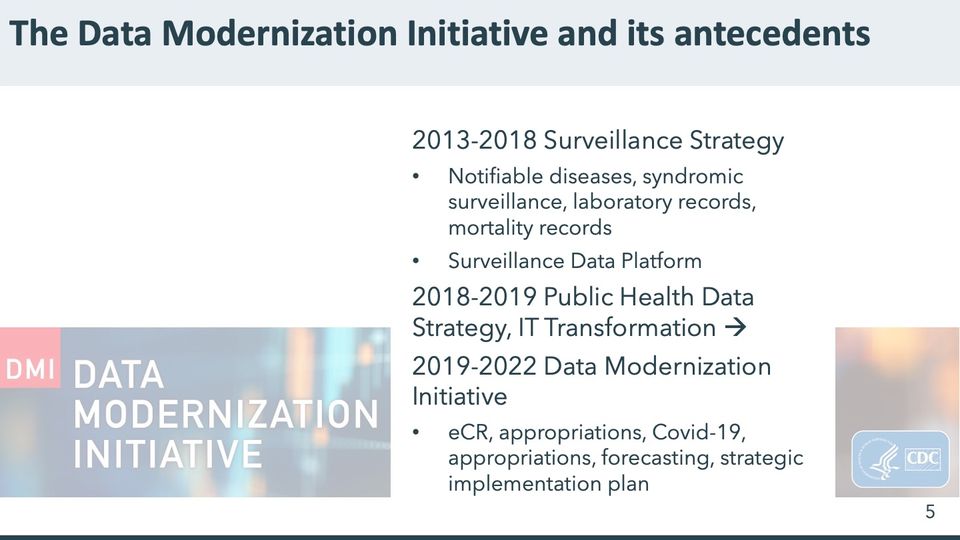
Slide 5The Data Modernization Initiative and its antecedents
2013-2018 Surveillance Strategy
Notifiable diseases, syndromic surveillance, laboratory records, mortality records
Surveillance Data Platform
2018-2019 Public Health Data Strategy, IT Transformation →
2019-2022 Data Modernization Initiative
eCR, appropriations, Covid-19, appropriations, forecasting, strategic implementation plan
Description
Text in the picture
DMI DATA MODERNIZATION INITIATIVE CDC
Abbreviations: CDC = Centers for Disease Control and Prevention; DMI = Data Modernization Initiative (CDC); eCR = electronic case reporting; IT = information technology.
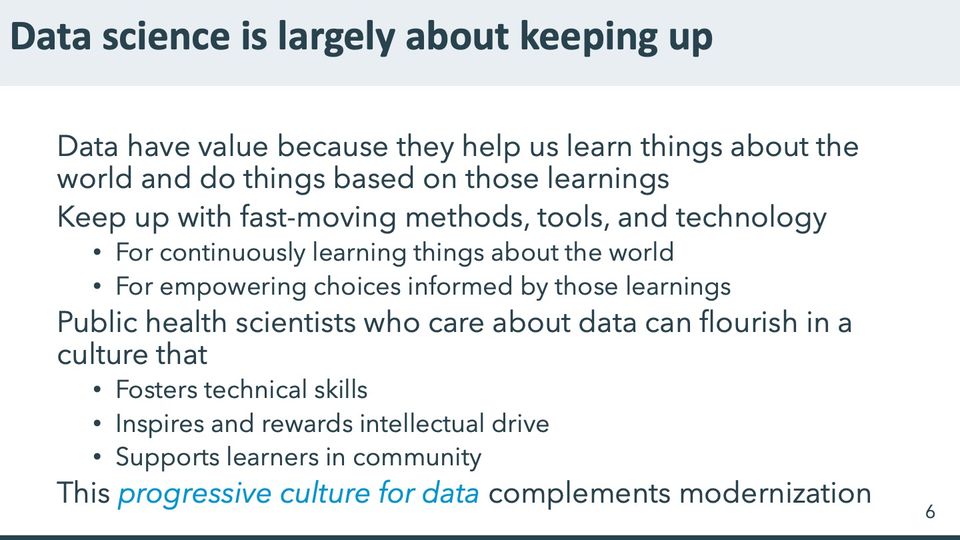
Slide 6Data science is largely about keeping up
Data have value because they help us learn things about the world and do things based on those learnings
Keep up with fast-moving methods, tools, and technology
For continuously learning things about the world
For empowering choices informed by those learnings
Public health scientists who care about data can flourish in a culture that
Fosters technical skills
Inspires and rewards intellectual drive
Supports learners in community
This progressive culture for data complements modernization
Slide 7Why should CDC care about data science?
Abbreviations: CDC = Centers for Disease Control and Prevention.
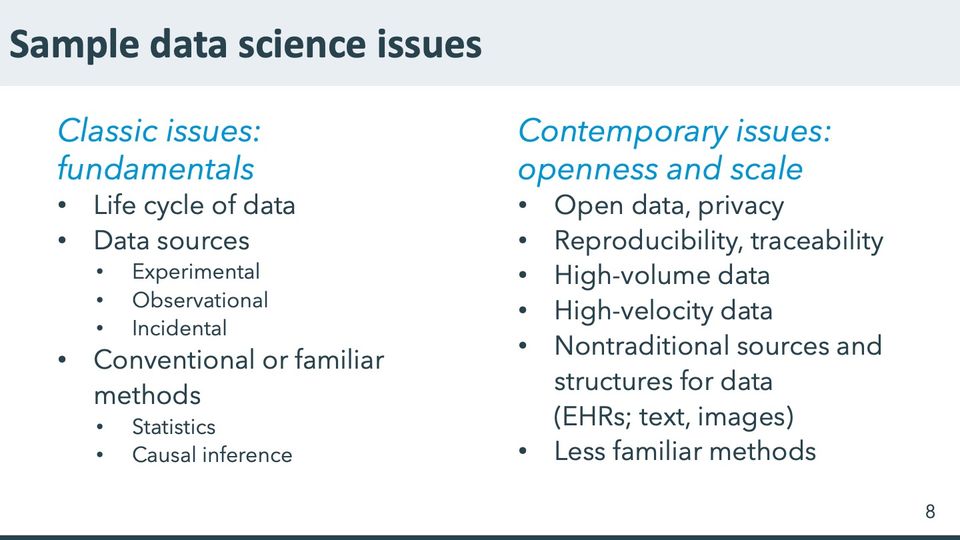
Slide 8Sample data science issues
Classic issues:
fundamentals
Life cycle of data
Data sources
Experimental
Observational
Incidental
Conventional or familiar methods
Statistics
Causal inference
Contemporary issues:
openness and scale
Open data, privacy
Reproducibility, traceability
High-volume data
High-velocity data
Nontraditional sources and structures for data
(EHRs; text, images)
Less familiar methods
Presenter notes
<Source: Peng and Matsui 2015, pages 10, 13>
Abbreviations: EHR = electronic health record.
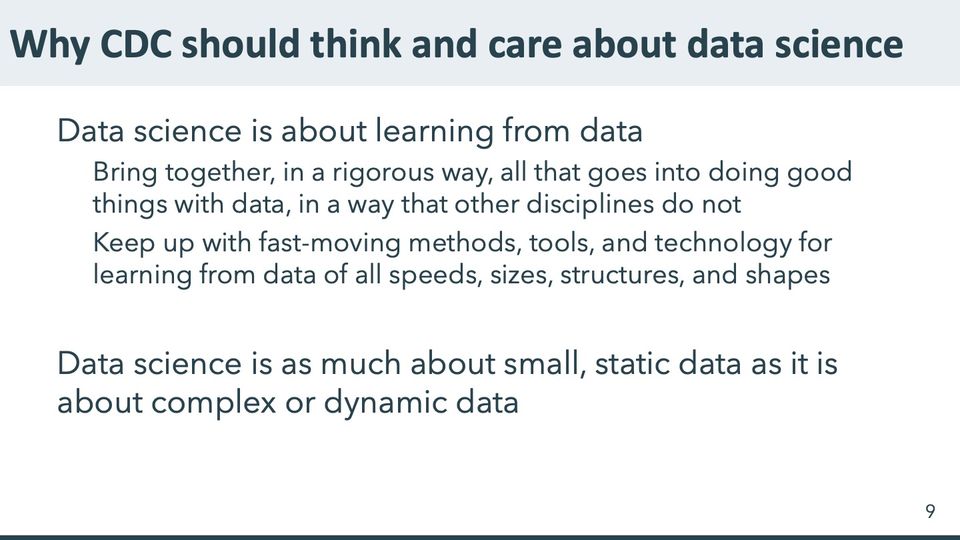
Slide 9Why CDC should think and care about data science
Data science is about learning from data
Bring together, in a rigorous way, all that goes into doing good things with data, in a way that other disciplines do not
Keep up with fast-moving methods, tools, and technology for learning from data of all speeds, sizes, structures, and shapes
Data science is as much about small, static data as it is about complex or dynamic data
Presenter notes
Foremost, data science is about learning from data. Its purpose is broadly to bring together, in a rigorous way, all that goes into doing good things with data. Data science helps us to keep up with evolving methods, tools, and technology for learning from data of all speeds, sizes, structures, and shapes in a way that other disciplines do not. Dynamic and complex technologies and data motivate but do not define data science.
Abbreviations: CDC = Centers for Disease Control and Prevention.
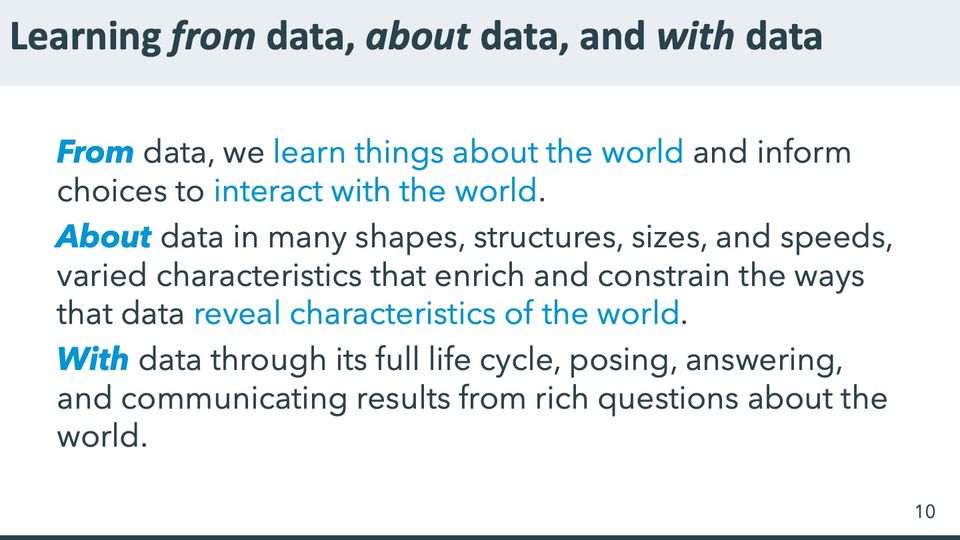
Slide 10Learning from data, about data, and with data
From data, we learn things about the world and inform choices to interact with the world.
About data in many shapes, structures, sizes, and speeds, varied characteristics that enrich and constrain the ways that data reveal characteristics of the world.
With data through its full life cycle, posing, answering, and communicating results from rich questions about the world.
Slide 11What is data science? And what is it not?
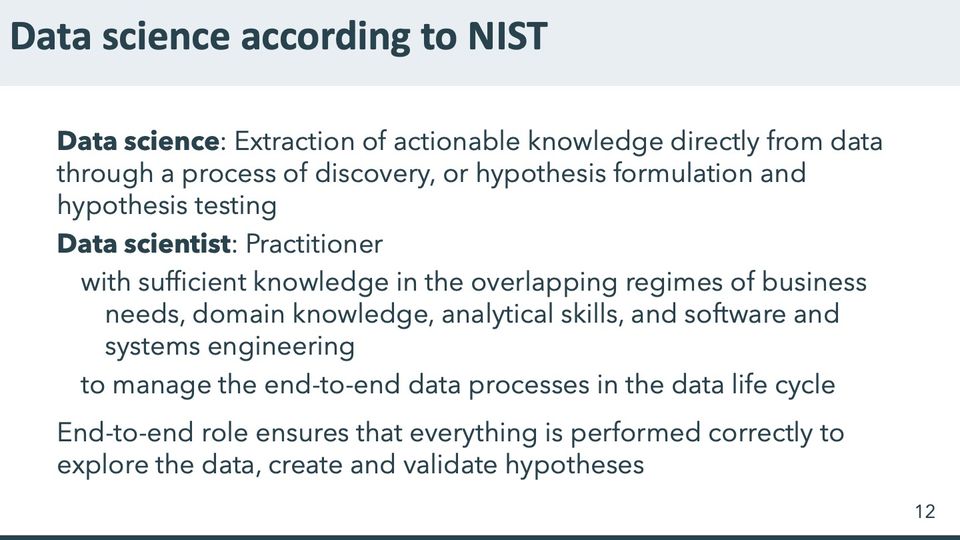
Slide 12Data science according to NIST
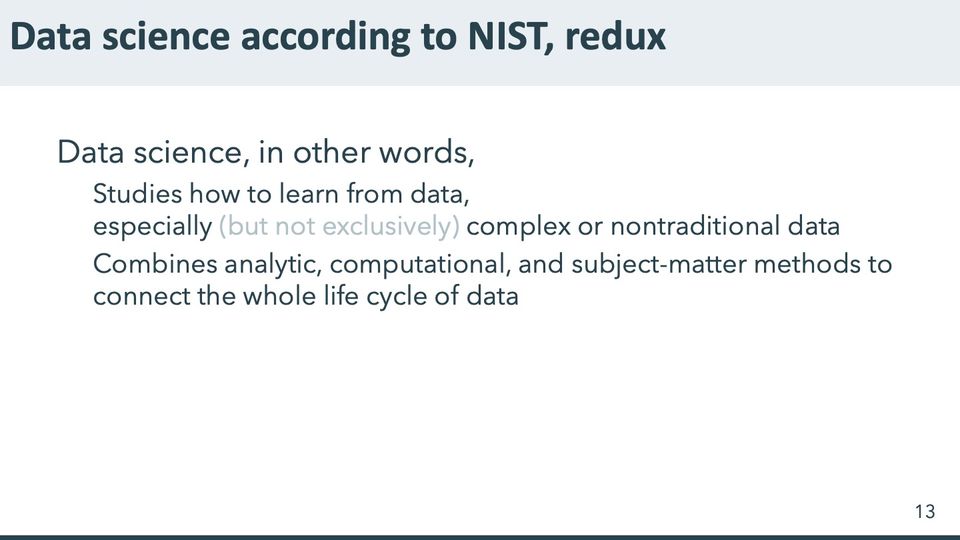
Data science: Extraction of actionable knowledge directly from data through a process of discovery, or hypothesis formulation and hypothesis testing
Data scientist: Practitioner
with sufficient knowledge in the overlapping regimes of business needs, domain knowledge, analytical skills, and software and systems engineering
to manage the end-to-end data processes in the data life cycle
End-to-end role ensures that everything is performed correctly to explore the data, create and validate hypotheses
Abbreviations: NIST = National Institute of Standards and Technology.
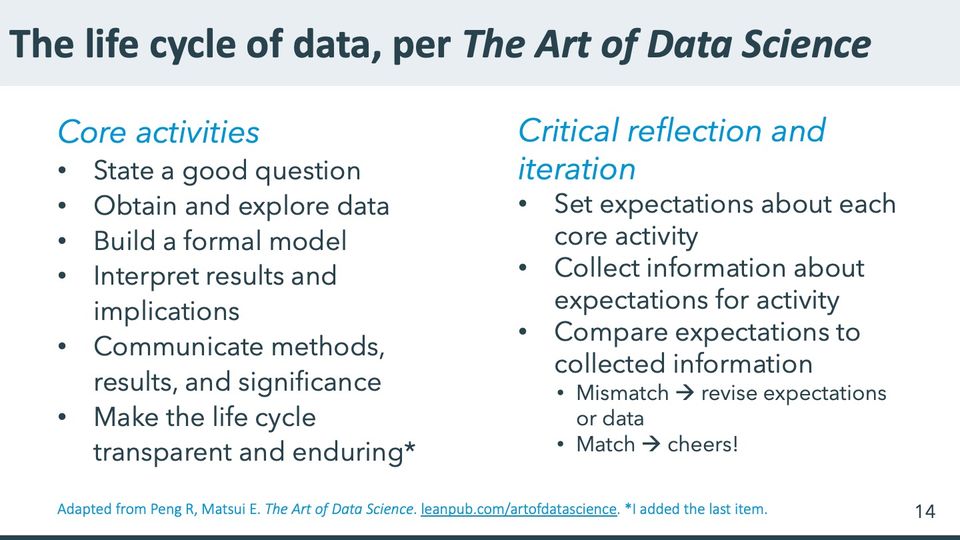
Slide 14The life cycle of data, per The Art of Data Science
Critical reflection and iteration
Set expectations about each core activity
Collect information about expectations for activity
Compare expectations to collected information
Mismatch → revise expectations or data
Match → cheers!
Core activities
State a good question
Obtain and explore data
Build a formal model
Interpret results and implications
Communicate methods, results, and significance
Make the life cycle transparent and enduring*
Adapted from Peng R, Matsui E. The Art of Data Science. leanpub.com/artofdatascience. *I added the last item.
Presenter notes
<Source: Peng and Matsui 2015, pages 10, 13>
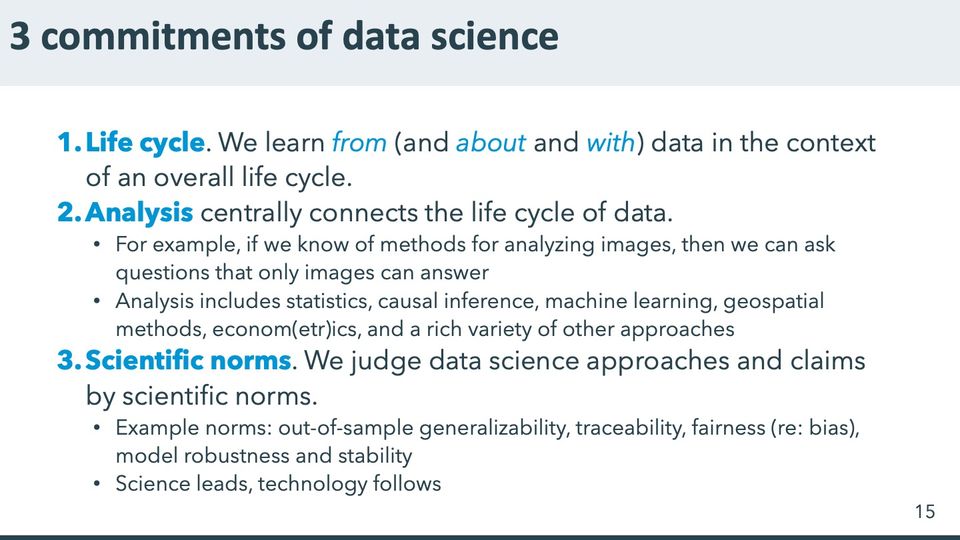
Slide 153 commitments of data science
Life cycle. We learn from (and about and with) data in the context of an overall life cycle.
Analysis centrally connects the life cycle of data.
For example, if we know of methods for analyzing images, then we can ask questions that only images can answer
Analysis includes statistics, causal inference, machine learning, geospatial methods, econom(etr)ics, and a rich variety of other approaches
Scientific norms. We judge data science approaches and claims by scientific norms.
Example norms: out-of-sample generalizability, traceability, fairness (re: bias), model robustness and stability
Science leads, technology follows
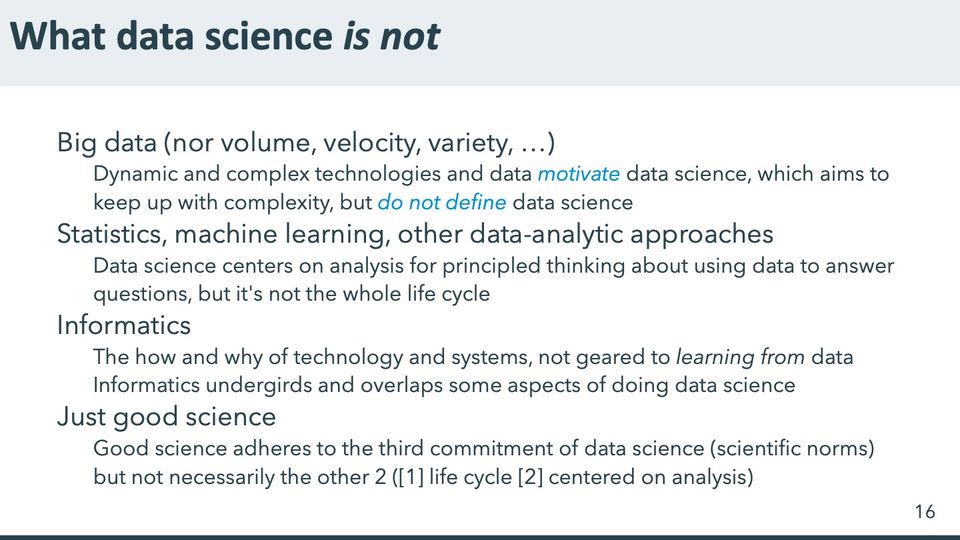
Slide 16What data science is not
Big data (nor volume, velocity, variety, …)
Dynamic and complex technologies and data motivate data science, which aims to keep up with complexity, but do not define data science
Statistics, machine learning, other data-analytic approaches
Data science centers on analysis for principled thinking about using data to answer questions, but it's not the whole life cycle
Informatics
The how and why of technology and systems, not geared to learning from data
Informatics undergirds and overlaps some aspects of doing data science
Just good science
Good science adheres to the third commitment of data science (scientific norms) but not necessarily the other 2 ([1] life cycle [2] centered on analysis)
Slide 17How should CDC support the practice of data science?
Abbreviations: CDC = Centers for Disease Control and Prevention.
Slide 18How CDC should support the practice of data science
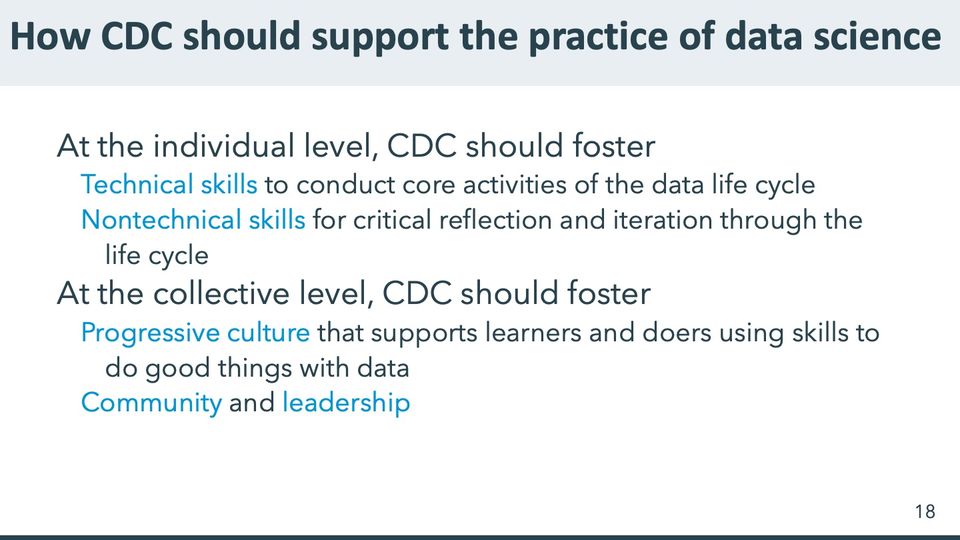
At the individual level, CDC should foster
Technical skills to conduct core activities of the data life cycle
Nontechnical skills for critical reflection and iteration through the life cycle
At the collective level, CDC should foster
Progressive culture that supports learners and doers using skills to do good things with data
Community and leadership
Presenter notes
At the individual level, data science calls for technical and nontechnical skills. At the collective level, it calls for a progressive culture that supports putting those skills to use for doing good things with data.
Abbreviations: CDC = Centers for Disease Control and Prevention.
Slide 19The life cycle of data—technical skills
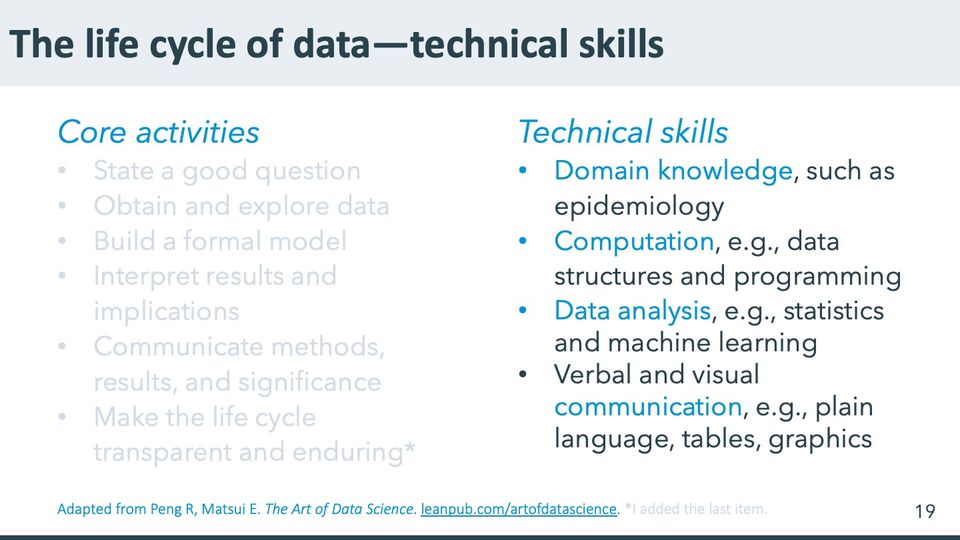
Core activities
State a good question
Obtain and explore data
Build a formal model
Interpret results and implications
Communicate methods, results, and significance
Make the life cycle transparent and enduring*
Technical skills
Domain knowledge, such as epidemiology
Computation, e.g., data structures and programming
Data analysis, e.g., statistics and machine learning
Verbal and visual communication, e.g., plain language, tables, graphics
Adapted from Peng R, Matsui E. The Art of Data Science. leanpub.com/artofdatascience. *I added the last item.
Presenter notes
Technical skills cover analytic methods, such as statistics, machine learning, or causal inference, and computational methods, such as data wrangling and implementing and scaling algorithms.
Slide 20The life cycle of data—nontechnical skills
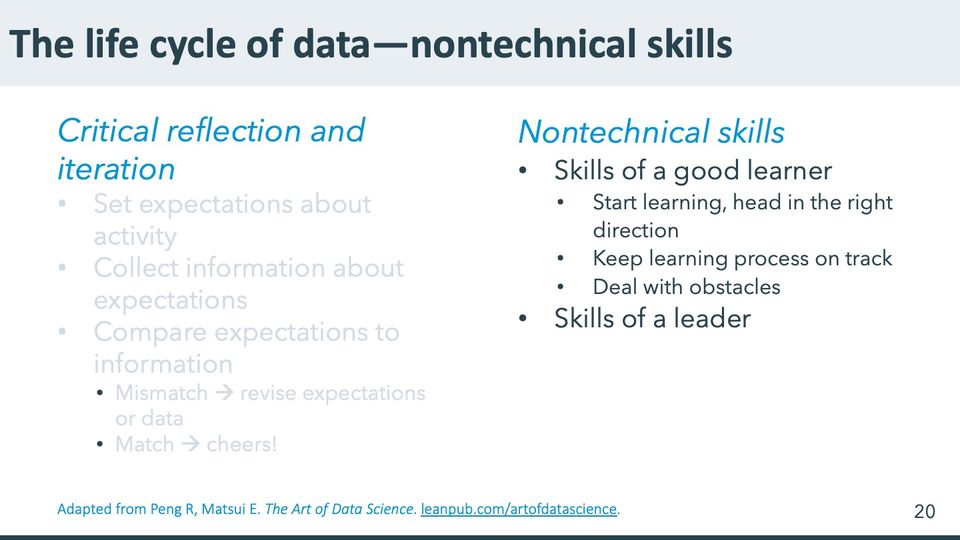
Critical reflection and iteration
Set expectations about activity
Collect information about expectations
Compare expectations to information
Mismatch → revise expectations or data
Match → cheers!
Nontechnical skills
Skills of a good learner
Start learning, head in the right direction
Keep learning process on track
Deal with obstacles
Skills of a leader
Adapted from Peng R, Matsui E. The Art of Data Science. leanpub.com/artofdatascience.
Presenter notes
<Source: > Nontechnical skills support good science generally and good data science specifically, such as the ability to approach a problem with curiosity, attentiveness, perseverance, open-mindedness, and creativity.
Slide 21Traits of a good learner: intellectual virtues
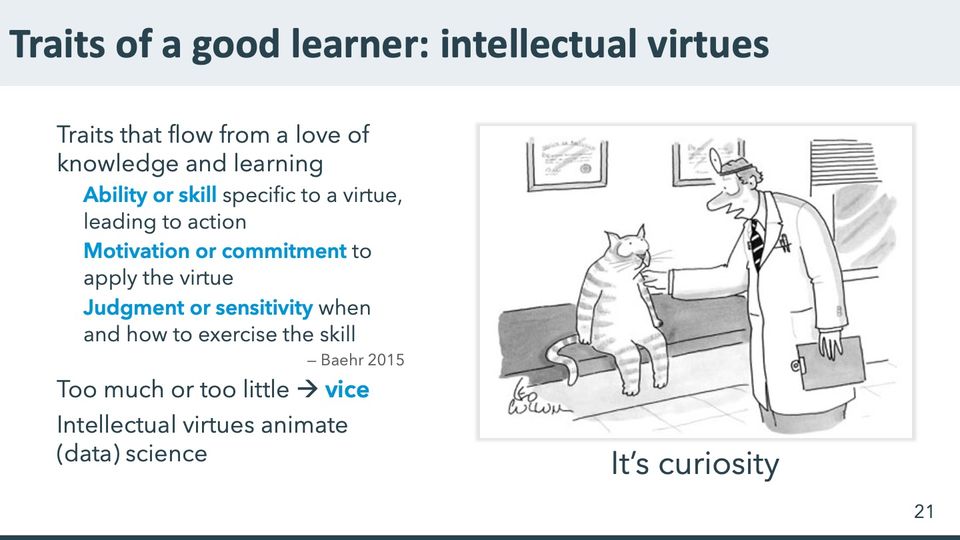
Traits that flow from a love of knowledge and learning
Ability or skill specific to a virtue, leading to action
Motivation or commitment to apply the virtue
Judgment or sensitivity when and how to exercise the skill
— Baehr 2015
Too much or too little → vice
Intellectual virtues animate (data) science
It’s curiosity
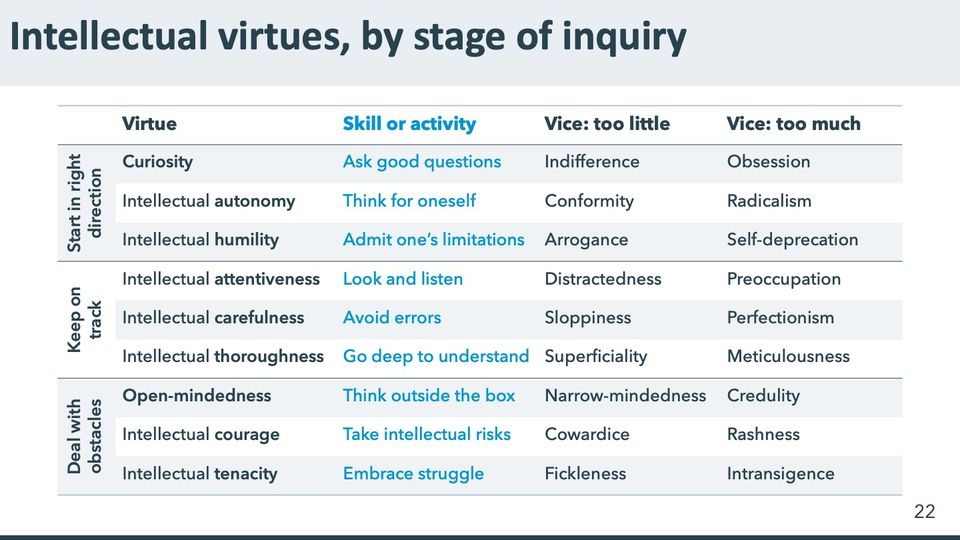
Slide 22Intellectual virtues, by stage of inquiry
Virtue
Skill or activity
Vice: too little
Vice: too much
Start in right direction
Curiosity
Ask good questions
Indifference
Obsession
Intellectual autonomy
Think for oneself
Conformity
Radicalism
Intellectual humility
Admit one’s limitations
Arrogance
Self-deprecation
Keep on track
Intellectual attentiveness
Look and listen
Distractedness
Preoccupation
Intellectual carefulness
Avoid errors
Sloppiness
Perfectionism
Intellectual thoroughness
Go deep to understand
Superficiality
Meticulousness
Deal with obstacles
Open-mindedness
Think outside the box
Narrow-mindedness
Credulity
Intellectual courage
Take intellectual risks
Cowardice
Rashness
Intellectual tenacity
Embrace struggle
Fickleness
Intransigence
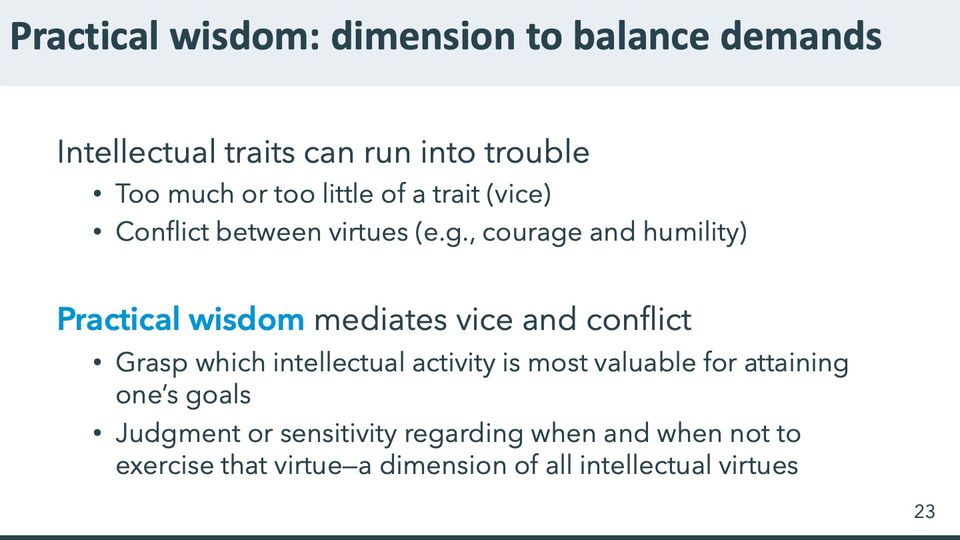
Slide 23Practical wisdom: dimension to balance demands
Intellectual traits can run into trouble
Too much or too little of a trait (vice)
Conflict between virtues (e.g., courage and humility)
Practical wisdom mediates vice and conflict
Grasp which intellectual activity is most valuable for attaining one’s goals
Judgment or sensitivity regarding when and when not to exercise that virtue—a dimension of all intellectual virtues
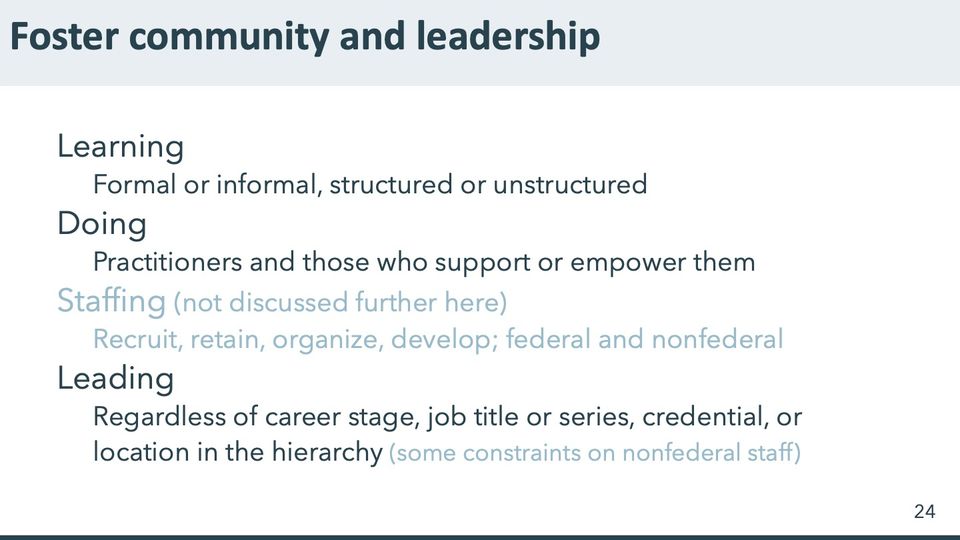
Slide 24Foster community and leadership
Learning
Formal or informal, structured or unstructured
Doing
Practitioners and those who support or empower them
Staffing (not discussed further here)
Recruit, retain, organize, develop; federal and nonfederal
Leading
Regardless of career stage, job title or series, credential, or location in the hierarchy (some constraints on nonfederal staff)
Slide 25Who gets to do data science?
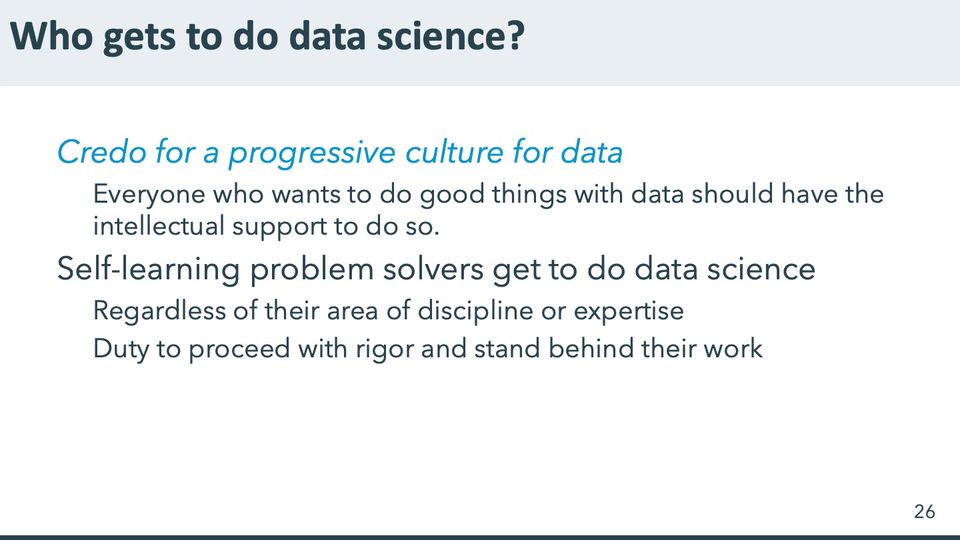
Slide 26Who gets to do data science?
Credo for a progressive culture for data
Everyone who wants to do good things with data should have the intellectual support to do so.
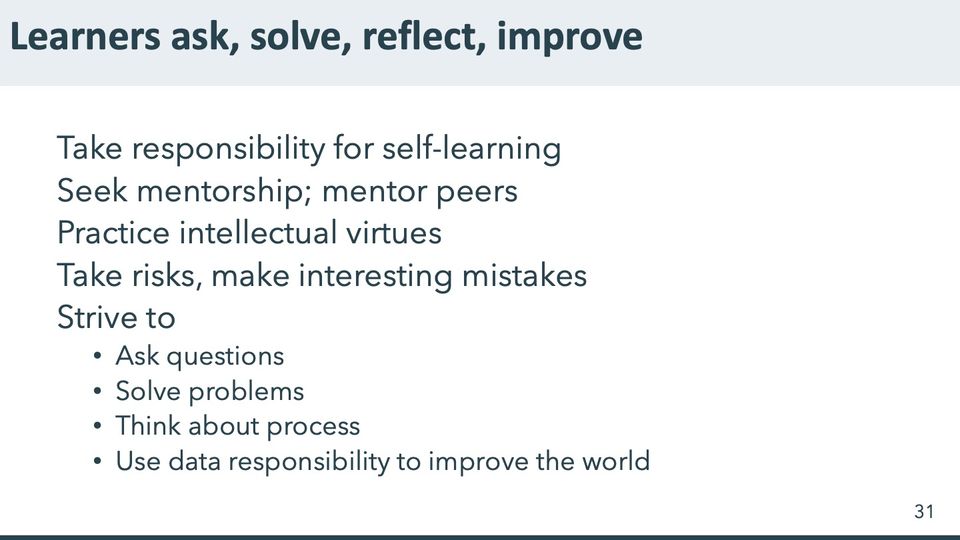
Self-learning problem solvers get to do data science
Regardless of their area of discipline or expertise
Duty to proceed with rigor and stand behind their work
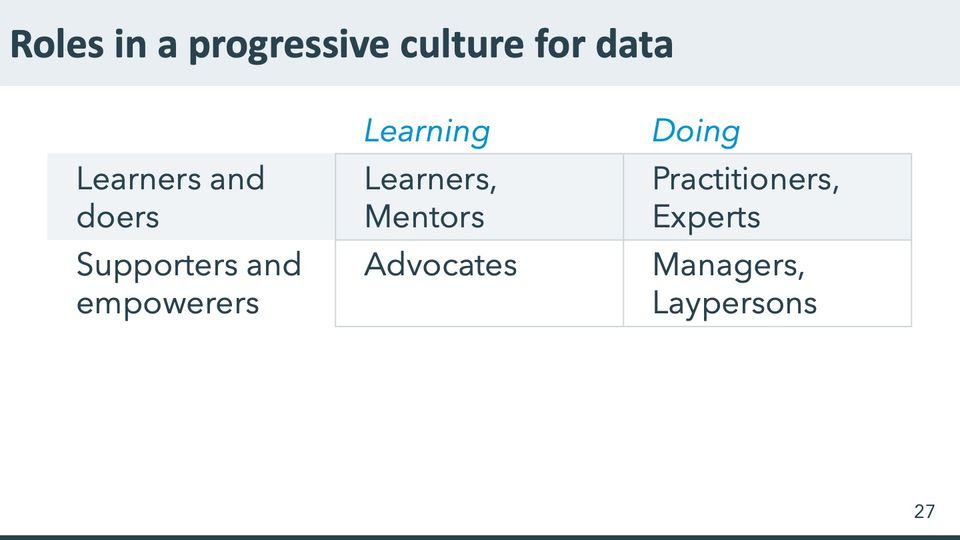
Slide 27Roles in a progressive culture for data
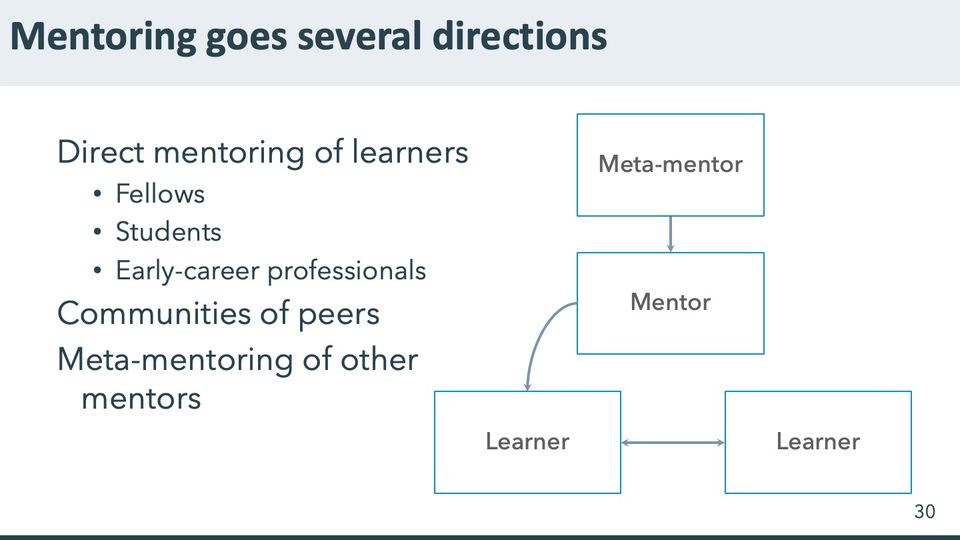
Learning
Doing
Learners and doers
Learners, / Mentors
Practitioners, / Experts
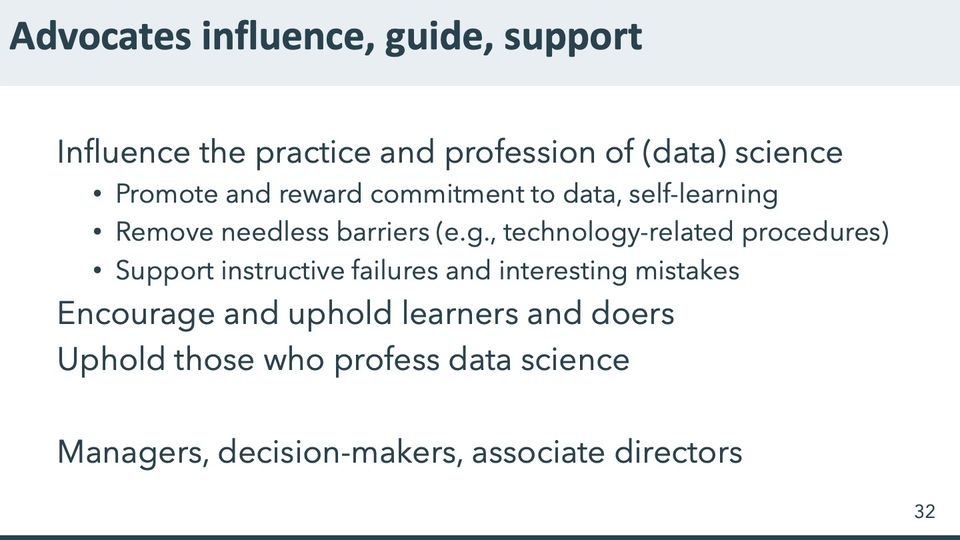
Supporters and empowerers
Advocates
Managers, / Laypersons
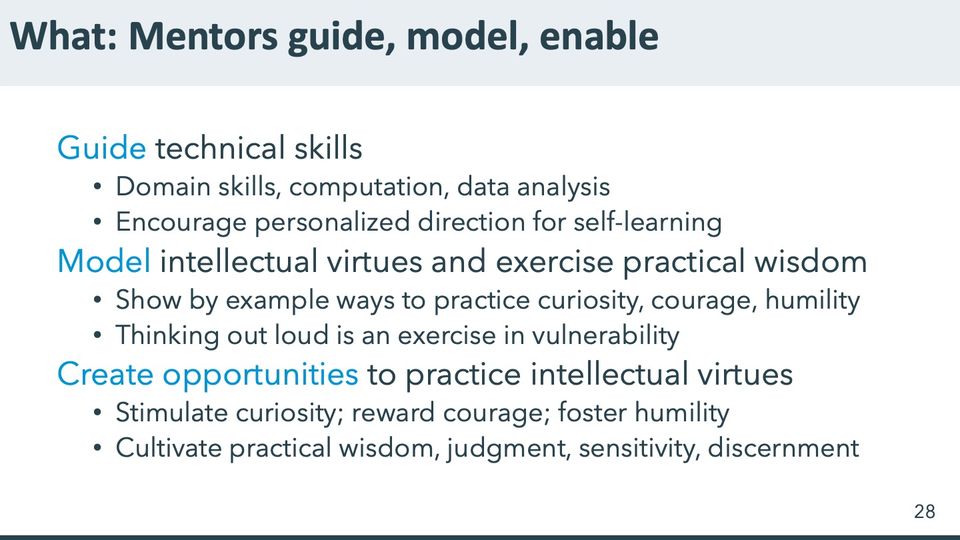
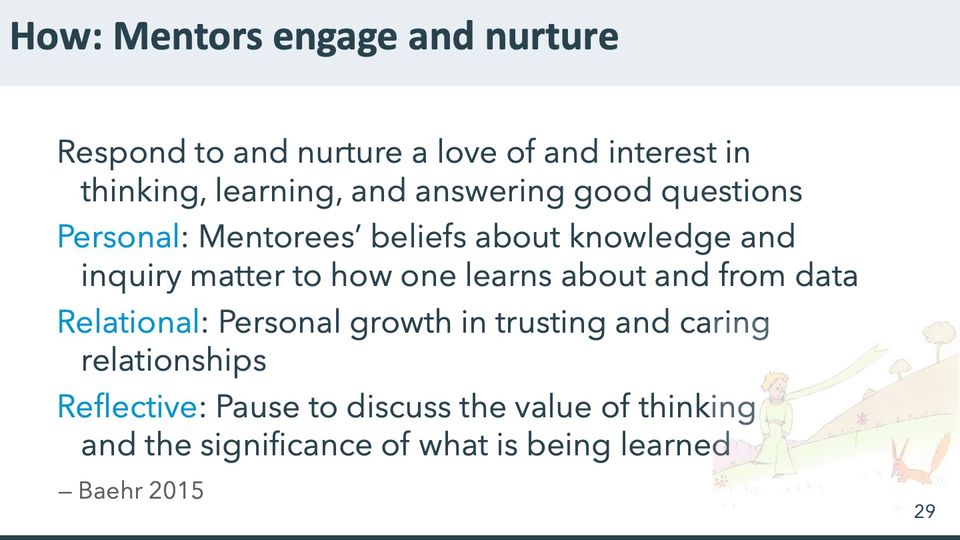
Slide 28What: Mentors guide, model, enable
Guide technical skills
Domain skills, computation, data analysis
Encourage personalized direction for self-learning
Model intellectual virtues and exercise practical wisdom
Show by example ways to practice curiosity, courage, humility
Thinking out loud is an exercise in vulnerability
Create opportunities to practice intellectual virtues
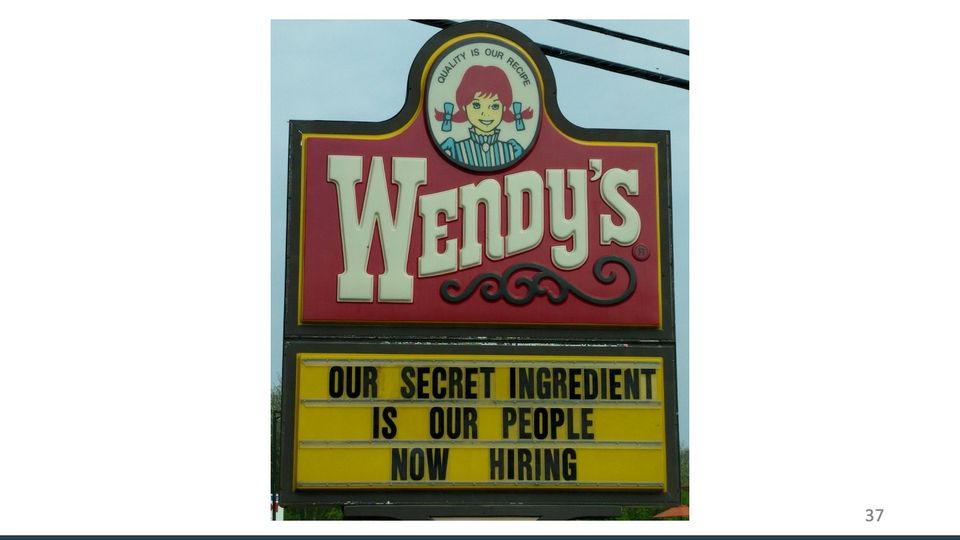
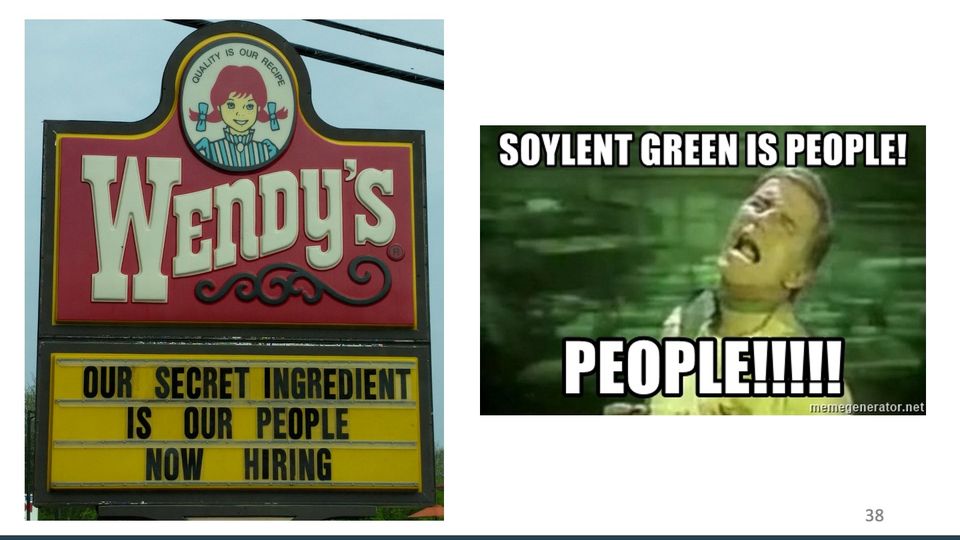
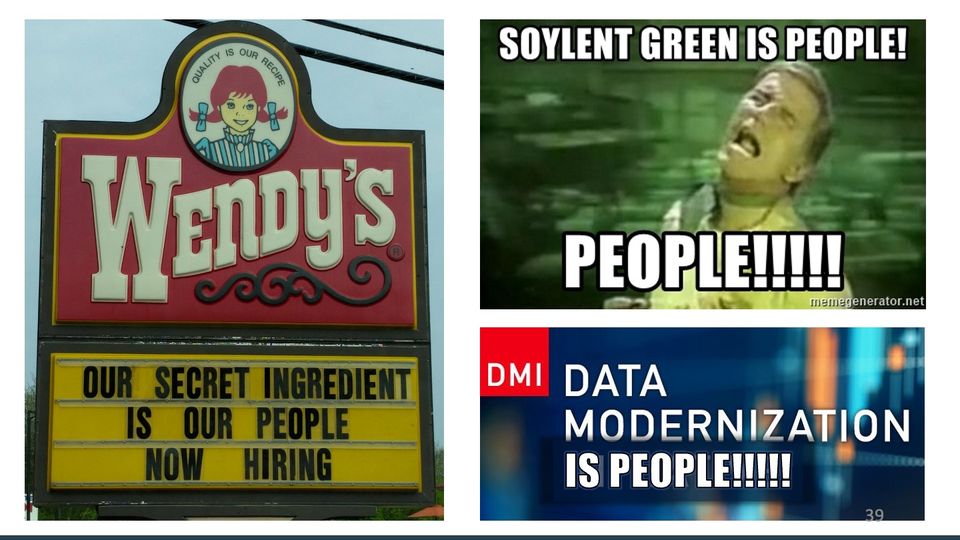
QUALITY IS OUR RECIPE WENDY'S OUR SECRET INGREDIENT IS OUR PEOPLE NOW HIRING SOYLENT GREEN IS PEOPLE! PEOPLE!!!!! memegenerator.net DMI DATA MODERNIZATION IS PEOPLE!!!!!
Abbreviations: DMI = Data Modernization Initiative (CDC).
Slide 40Discussion
Chad Heilig, PhD • [redacted: email address] Associate Director for Data Science
Description
The network pattern spreads across the top and right of the slide behind the heading, in very light gray dots joined by thin lines. The redacted region sits on the line with the presenter's name, immediately after the bullet. The logo at lower left is a dark blue holding a white eagle-profile seal and the letters CDC.
Text in the picture
CDC
Abbreviations: CDC = Centers for Disease Control and Prevention.
Slide 41Why a progressive culture for data
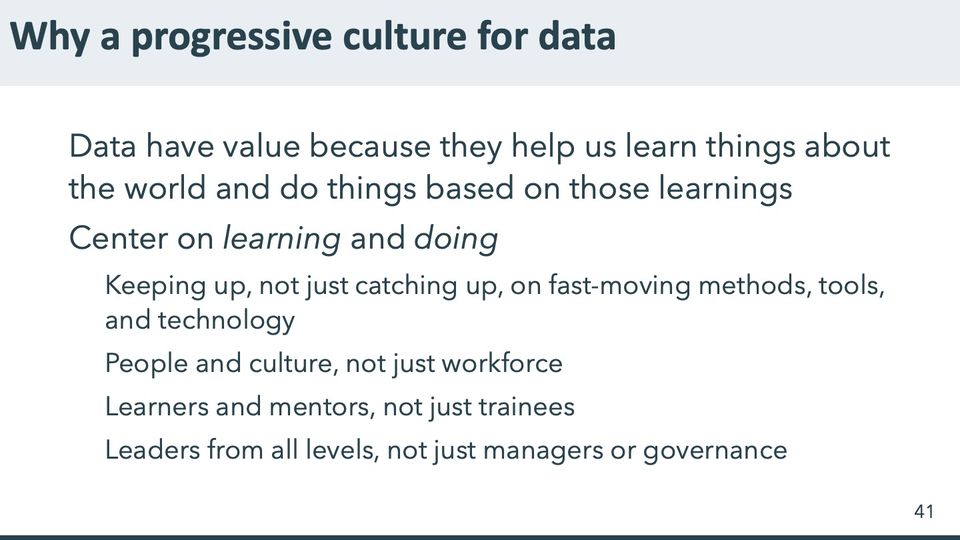
Data have value because they help us learn things about the world and do things based on those learnings
Center on learning and doing
Keeping up, not just catching up, on fast-moving methods, tools, and technology
People and culture, not just workforce
Learners and mentors, not just trainees
Leaders from all levels, not just managers or governance
Slide 42Core activities, critical reflection and iteration
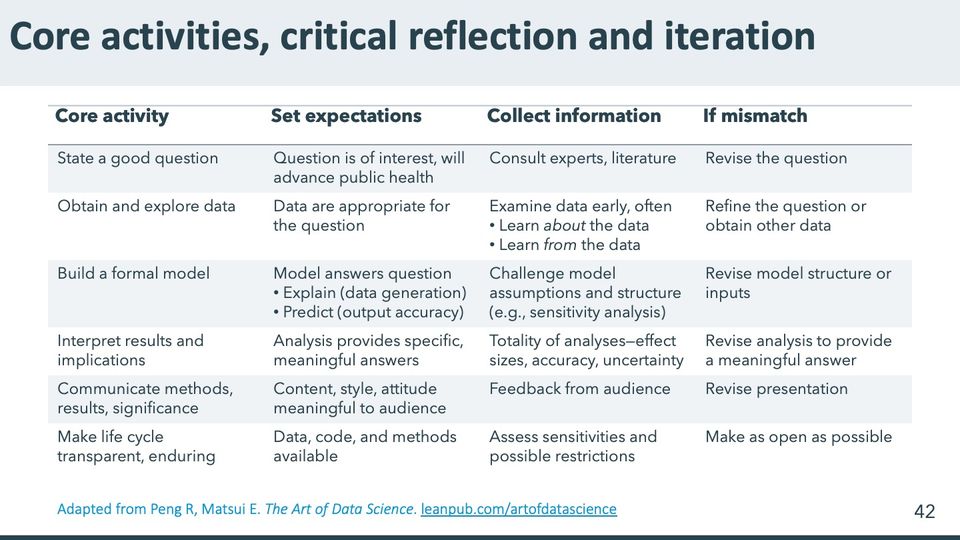
Core activity
Set expectations
Collect information
If mismatch
State a good question
Question is of interest, will advance public health
Consult experts, literature
Revise the question
Obtain and explore data
Data are appropriate for the question
Examine data early, often / Learn about the data / Learn from the data
Challenge model assumptions and structure (e.g., sensitivity analysis)
Revise model structure or inputs
Interpret results and implications
Analysis provides specific, meaningful answers
Totality of analyses—effect sizes, accuracy, uncertainty
Revise analysis to provide a meaningful answer
Communicate methods, results, significance
Content, style, attitude meaningful to audience
Feedback from audience
Revise presentation
Make life cycle transparent, enduring
Data, code, and methods available
Assess sensitivities and possible restrictions
Make as open as possible
Adapted from Peng R, Matsui E. The Art of Data Science. leanpub.com/artofdatascience
Slide 43Intellectual virtues and skills, by stage of inquiry
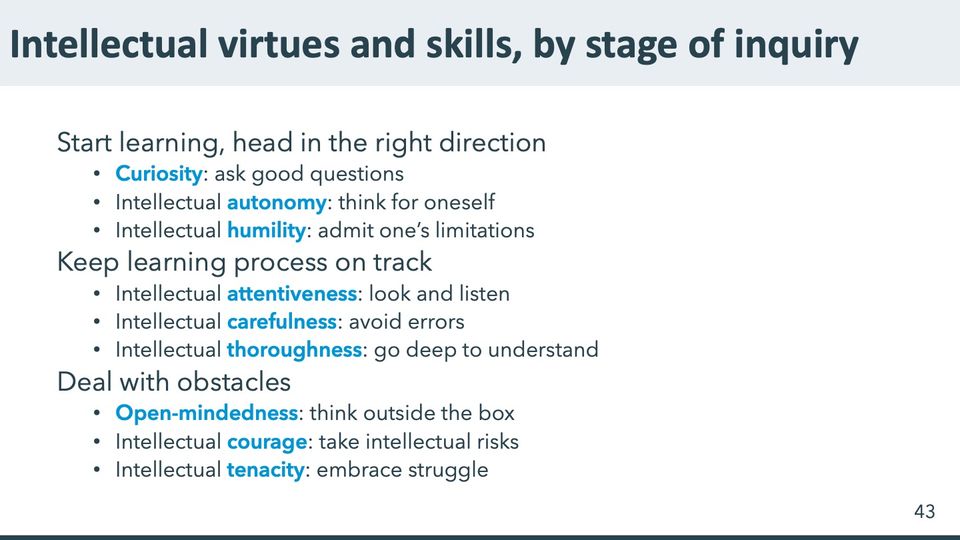
Start learning, head in the right direction
Curiosity: ask good questions
Intellectual autonomy: think for oneself
Intellectual humility: admit one’s limitations
Keep learning process on track
Intellectual attentiveness: look and listen
Intellectual carefulness: avoid errors
Intellectual thoroughness: go deep to understand
Deal with obstacles
Open-mindedness: think outside the box
Intellectual courage: take intellectual risks
Intellectual tenacity: embrace struggle
Slide 44Start learning and head in the right direction
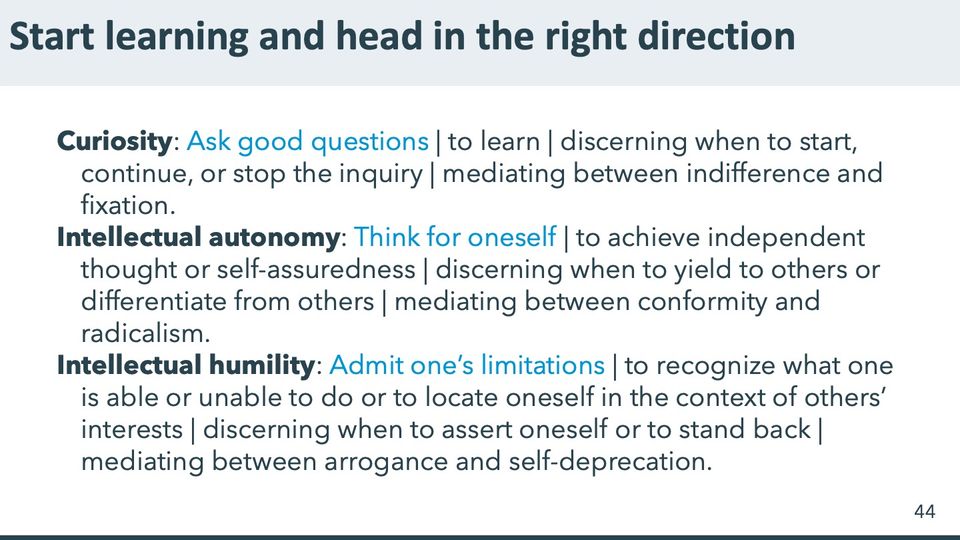
Curiosity: Ask good questions | to learn | discerning when to start, continue, or stop the inquiry | mediating between indifference and fixation.
Intellectual autonomy: Think for oneself | to achieve independent thought or self-assuredness | discerning when to yield to others or differentiate from others | mediating between conformity and radicalism.
Intellectual humility: Admit one’s limitations | to recognize what one is able or unable to do or to locate oneself in the context of others’ interests | discerning when to assert oneself or to stand back | mediating between arrogance and self-deprecation.
Presenter notes
Each stage-related virtue uses the pipe character (“|”) to delimit the virtue’s corresponding ability or skill (in blue), motivation or commitment, judgment or sensitivity, and vices representing too much or too little of the virtue.
Slide 45Keep the learning process on track
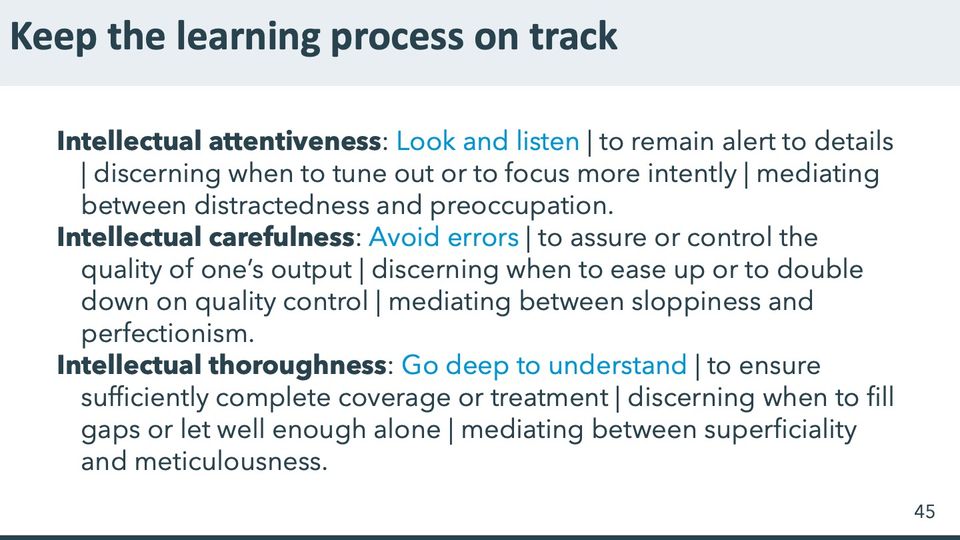
Intellectual attentiveness: Look and listen | to remain alert to details | discerning when to tune out or to focus more intently | mediating between distractedness and preoccupation.
Intellectual carefulness: Avoid errors | to assure or control the quality of one’s output | discerning when to ease up or to double down on quality control | mediating between sloppiness and perfectionism.
Intellectual thoroughness: Go deep to understand | to ensure sufficiently complete coverage or treatment | discerning when to fill gaps or let well enough alone | mediating between superficiality and meticulousness.
Presenter notes
Each stage-related virtue uses the pipe character (“|”) to delimit the virtue’s corresponding ability or skill (in blue), motivation or commitment, judgment or sensitivity, and vices representing too much or too little of the virtue.
Slide 46Deal with obstacles
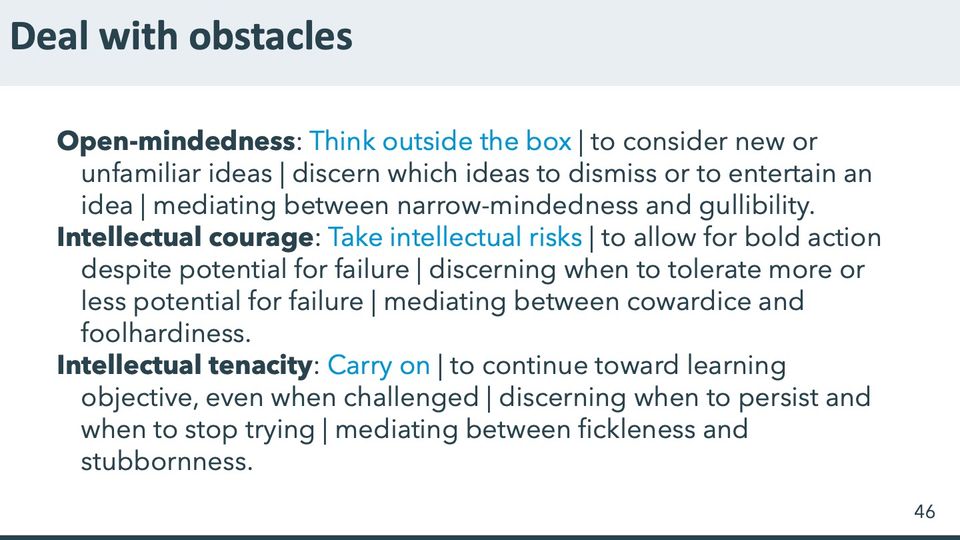
Open-mindedness: Think outside the box | to consider new or unfamiliar ideas | discern which ideas to dismiss or to entertain an idea | mediating between narrow-mindedness and gullibility.
Intellectual courage: Take intellectual risks | to allow for bold action despite potential for failure | discerning when to tolerate more or less potential for failure | mediating between cowardice and foolhardiness.
Intellectual tenacity: Carry on | to continue toward learning objective, even when challenged | discerning when to persist and when to stop trying | mediating between fickleness and stubbornness.
Presenter notes
Each stage-related virtue uses the pipe character (“|”) to delimit the virtue’s corresponding ability or skill (in blue), motivation or commitment, judgment or sensitivity, and vices representing too much or too little of the virtue.
Slide 47Intellectual virtues are cultivated (learned, not taught)
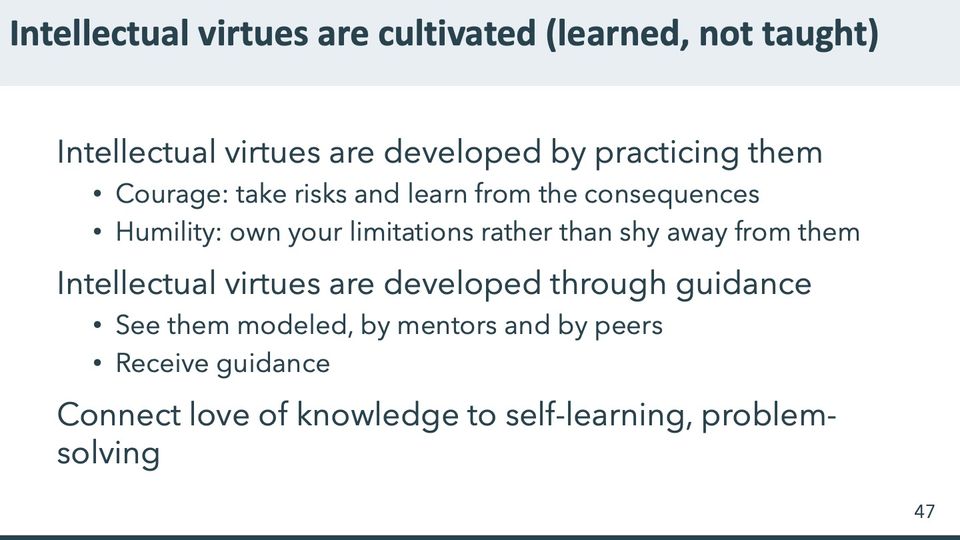
Intellectual virtues are developed by practicing them
Courage: take risks and learn from the consequences
Humility: own your limitations rather than shy away from them
Intellectual virtues are developed through guidance
See them modeled, by mentors and by peers
Receive guidance
Connect love of knowledge to self-learning, problem-solving
Slide 48Values
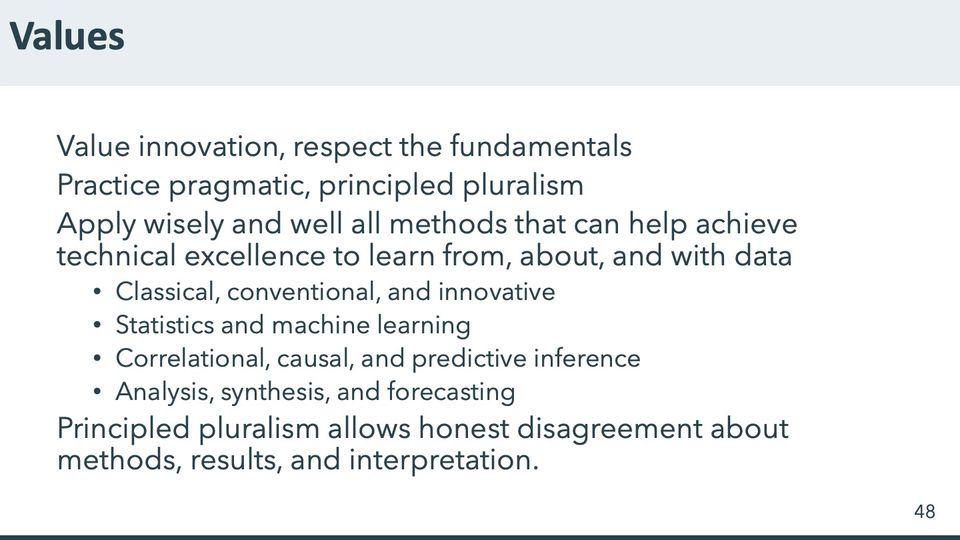
Value innovation, respect the fundamentals
Practice pragmatic, principled pluralism
Apply wisely and well all methods that can help achieve technical excellence to learn from, about, and with data
Classical, conventional, and innovative
Statistics and machine learning
Correlational, causal, and predictive inference
Analysis, synthesis, and forecasting
Principled pluralism allows honest disagreement about methods, results, and interpretation.
Slide 49Ethical conduct fosters trust
Foster public trust, motivated by public service to conduct itself ethically
Protect privacy
Ensure that data and methods are radically open and transparent
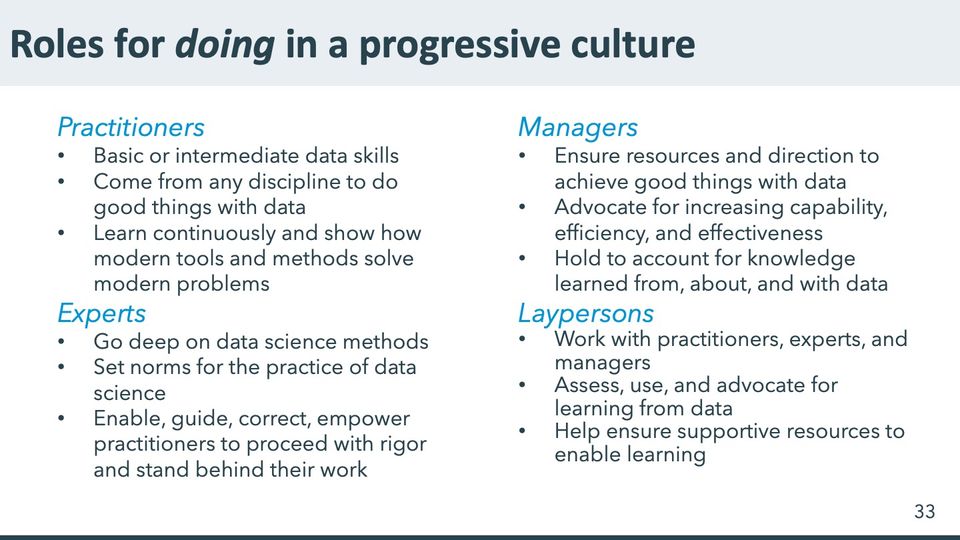
Slide 50Practitioners
Basic or intermediate data skills
Come from any discipline to do good things with data
Everyone who wants to do good things with data has the intellectual support to do so, accepting that they must proceed with rigor and stand behind their work
Practitioners learn continuously and show how modern tools and methods solve modern problems
Slide 51Experts
Go deep on data science methods
Help ensure that everyone who wants to do good things with data, can
Set norms for the practice of data science and for learning from, about, and with data
Enable, guide, correct, and empower practitioners to proceed with rigor and stand behind their work
Slide 52Managers
Ensure that practitioners and experts have resources and direction to achieve good things with data
Foster and reward curiosity
Invest in learning (not just training)
Encourage innovation and interesting mistakes
Advocate for means to enable practitioners and experts to continue increasing capability, efficiency, and effectiveness
Hold practitioners and experts to account for producing knowledge learned from, about, and with data
Slide 53Laypersons
Work in community with practitioners, experts, and managers
Literate in the value of data to help learn things about the world
Know how to assess, use, and advocate for learning from data
Help ensure supportive resources to enable learning
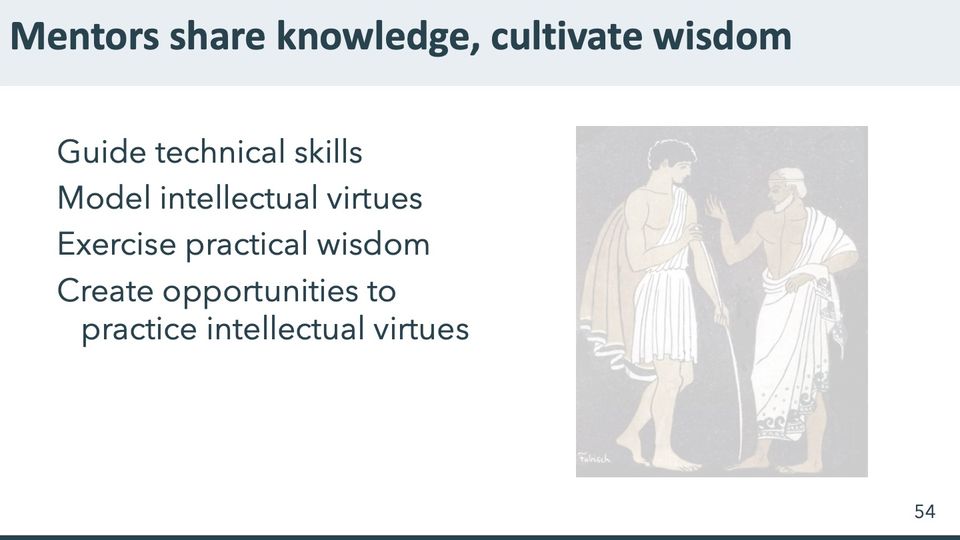
Slide 54Mentors share knowledge, cultivate wisdom
Guide technical skills
Model intellectual virtues
Exercise practical wisdom
Create opportunities to practice intellectual virtues
Description
Text in the picture
Fabisch
Slide 55Community of mentors and peers
Fellowships (EIS, PE, PHI, PM) and some structured programs (DSU) foster communities of peers
Students and ORISE tend to lack organized community
Interest groups and workgroups
SAG, RUG, PUG, HERG; SciComp
CDC Data Hub communities of practice (e.g., CMS, MarketScan)
Abbreviations: CDC = Centers for Disease Control and Prevention; CMS = Centers for Medicare & Medicaid Services; DSU = Data Science Upskilling (CDC program); EIS = Epidemic Intelligence Service (CDC); HERG = Health Economics Research Group (CDC); ORISE = Oak Ridge Institute for Science and Education; PE = Prevention Effectiveness (Fellowship, CDC); PHI = Public Health Informatics (Fellowship); PM = Preventive Medicine (Residency and Fellowship, CDC).
Slide 56The Data Modernization Initiative should
Engage data practitioners and experts as co-leaders
(put the data in DMI)
Engage early-career professionals as co-leaders
(put the modernization in DMI)
Emphasize that science leads technology and that technology opens possibility but follows science
Espouse scientific quality and rigor as primary goods
Promote leadership, empowerment, and wise innovation as the affirming manifestation of governance
Find out from prospective talent what they want and need in order to be recruited and retained
Presenter notes
The Data Modernization Initiative has Acknowledged the need to recruit and retain data talent Not adequately engaged data practitioners and experts as co-leaders Not adequately engaged early-career professionals as co-leaders Touted “world-class analytics” with no explicit connection to the scientific foundation for analysis Omitted mention of scientific quality and rigor from its strategic implementation plan
Abbreviations: DMI = Data Modernization Initiative (CDC).
Slide 57 is omitted.
Slide 58 is omitted.
Slide 59 is omitted.
Slide 60 is omitted.
Slide 61 is omitted.
Slide 62 is omitted.
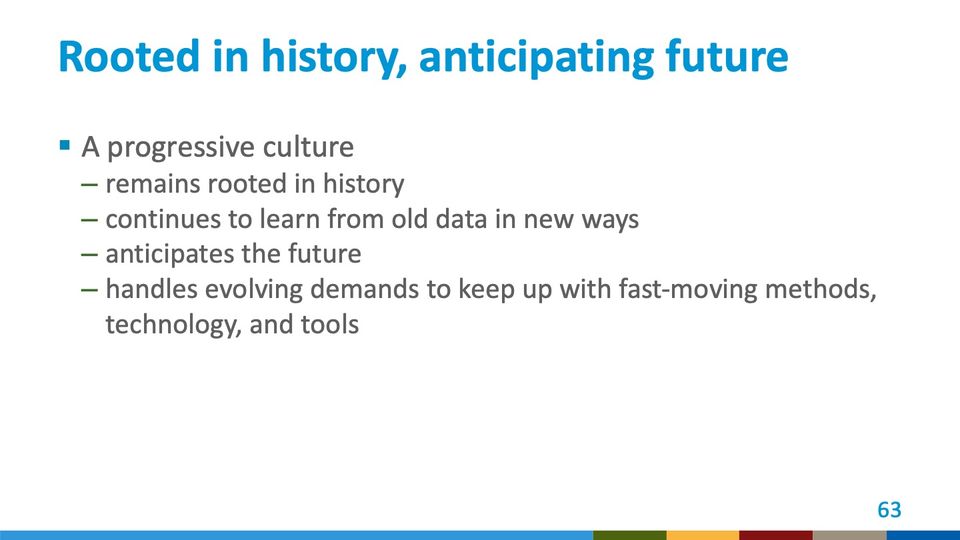
Slide 63Rooted in history, anticipating future
A progressive culture
remains rooted in history
continues to learn from old data in new ways
anticipates the future
handles evolving demands to keep up with fast-moving methods, technology, and tools
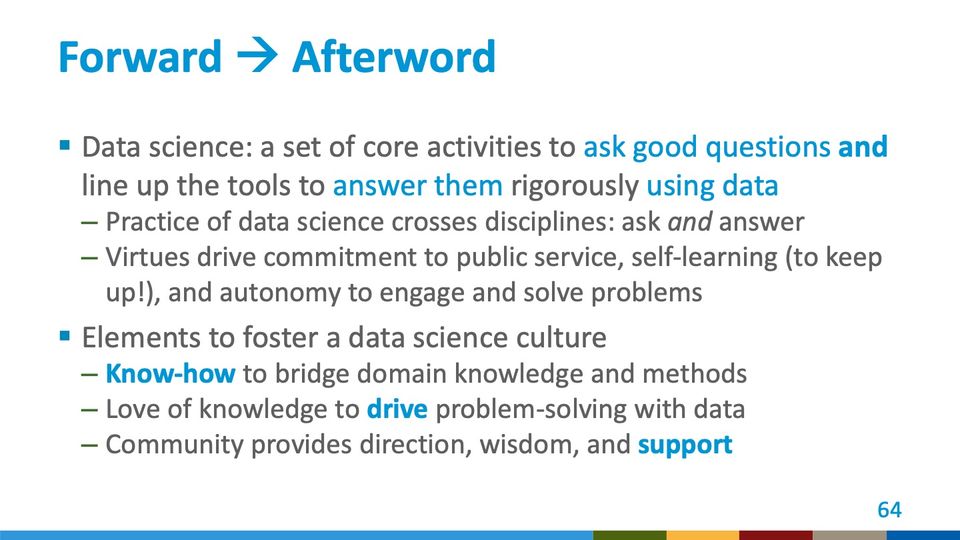
Slide 64Forward → Afterword
Data science: a set of core activities to ask good questions and line up the tools to answer them rigorously using data
Practice of data science crosses disciplines: ask and answer
Virtues drive commitment to public service, self-learning (to keep up!), and autonomy to engage and solve problems
Elements to foster a data science culture
Know-how to bridge domain knowledge and methods
Love of knowledge to drive problem-solving with data
Community provides direction, wisdom, and support
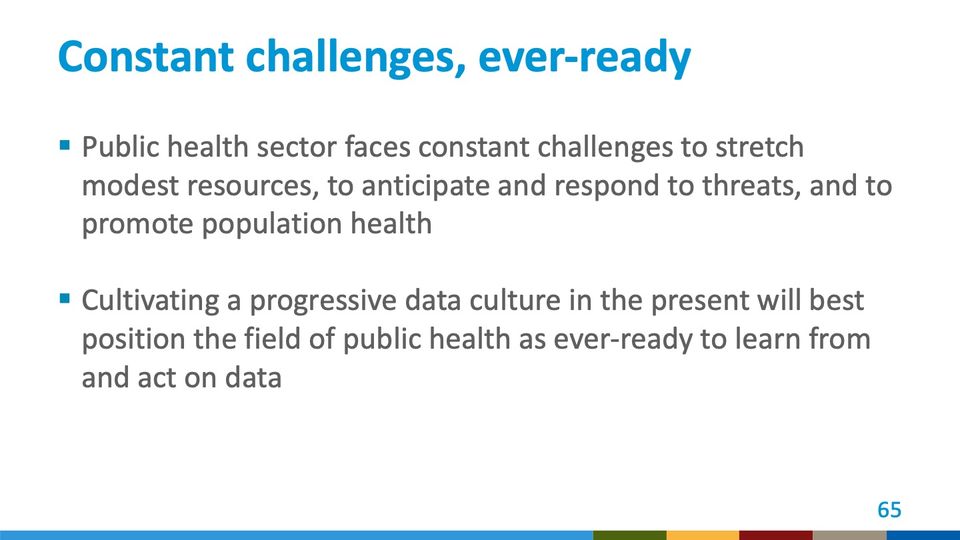
Slide 65Constant challenges, ever-ready
Public health sector faces constant challenges to stretch modest resources, to anticipate and respond to threats, and to promote population health
Cultivating a progressive data culture in the present will best position the field of public health as ever-ready to learn from and act on data
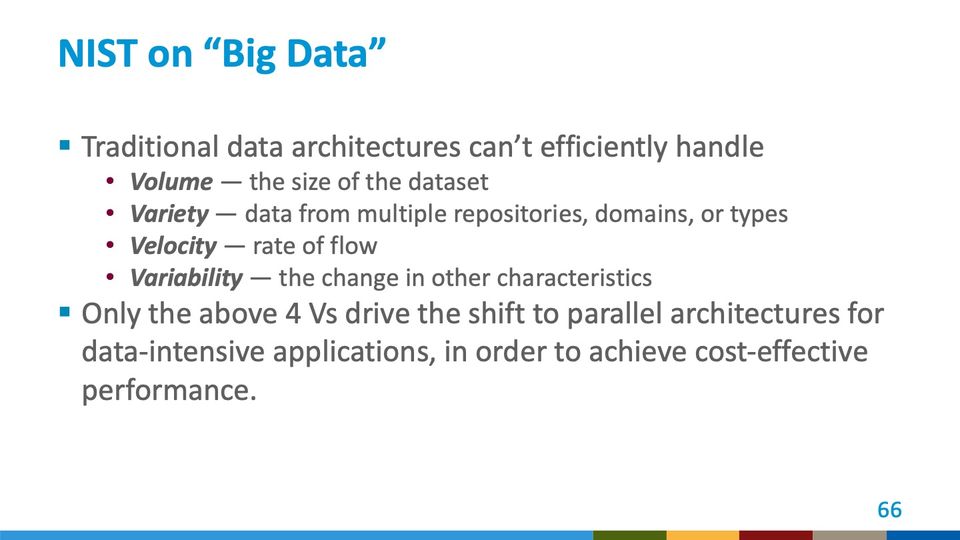
Slide 66NIST on “Big Data”
Traditional data architectures can’t efficiently handle
Volume — the size of the dataset
Variety — data from multiple repositories, domains, or types
Velocity — rate of flow
Variability — the change in other characteristics
Only the above 4 Vs drive the shift to parallel architectures for data-intensive applications, in order to achieve cost-effective performance.
Abbreviations: NIST = National Institute of Standards and Technology.
Slide 67Office of Personnel Management
Practitioners with sufficient knowledge in the areas of business needs, domain knowledge, analytical skills, and software and systems engineering to manage the end-to-end data processes in the data life cycle
Overlapping skills including data analysis, analytical applications, big data engineering, algorithms, domain expertise, statistics and machine learning
Use expertise in one [corrected: or] more of these domains to solve complex data problems
Interdisciplinary field of inquiry in which quantitative and analytical approaches, processes, and systems are developed and used to extract knowledge and insights from increasingly large and/or complex sets of data.
Abbreviations: NIH = National Institutes of Health.
Slide 69National Academies of Sciences, Engineering, and Medicine
Multidisciplinary and interdisciplinary approaches to extracting knowledge or insights from data
Relies on processes and systems (mathematical, computational, and social) to derive information or insights from data
Synthesize most relevant parts of the foundational disciplines to solve particular classes of problems or applications
Create novel techniques to fill between those disciplines where no approaches yet exist
Presenter notes
National Academies of Sciences, Engineering, and Medicine. Envisioning the Data Science Discipline: The Undergraduate Perspective: Interim Report (2018). http://nap.edu/24886; https://doi.org/10.17226/24886
Abbreviations
CDC = Centers for Disease Control and Prevention; CMS = Centers for Medicare & Medicaid Services; CSELS = Center for Surveillance, Epidemiology, and Laboratory Services (CDC); DDPHSS = Deputy Director for Public Health Science and Surveillance (CDC); DMI = Data Modernization Initiative (CDC); DSU = Data Science Upskilling (CDC program); eCR = electronic case reporting; EHR = electronic health record; EIS = Epidemic Intelligence Service (CDC); HERG = Health Economics Research Group (CDC); HHS = Department of Health and Human Services; IT = information technology; NIH = National Institutes of Health; NIST = National Institute of Standards and Technology; ORISE = Oak Ridge Institute for Science and Education; PE = Prevention Effectiveness (Fellowship, CDC); PHI = Public Health Informatics (Fellowship); PM = Preventive Medicine (Residency and Fellowship, CDC); YPN = Young Professionals Network (CDC).
References, compiled for this page
Full citations, with current links, for selected references and related works.